
Baits and baiting (4/10)

Fourth instalment of the CapseMaster series: boilies, pop-ups, sweetcorn, tiger nuts, particles and PVA, their upsides and risks, and a practical system for deciding how much to bait up based on seven variables.
Fourth part of the CapseMaster series: the baits available in Spain, when to use each one, and a practical system for deciding how much to bait up.
Baits
Bait is the last decision, not the first. But once the spot is chosen, it decides whether the fish that passes over stops or moves on.
Before you buy anything: check which baits are legal where you're fishing. In Spain, authorised baits are set by the closed-season order and vary by region and by water body. Two real, verifiable examples: in Castilla-La Mancha, on the Alarcón, Rosarito and Azután reservoirs and a stretch of the Tagus, the 2026 order expressly bans "fishing with egg-hardened pastes such as pellets, boilies and similar". In the Community of Madrid, outside trout waters, the authorised natural baits are worm, caddis larva, bloodworm, maggot, sweetcorn, boiled potato, river roe and mixtures of natural materials — a list that doesn't mention boilies. Check before every trip.
Boilies
A ball of paste made from flours, egg and attractors, boiled to form a crust that hardens it and slows the release of attractor. Its main function is selectivity: an 18 mm boilie resists bleak, crayfish and small cyprinids for hours.
Boilie families and when they stand out in Spain:
- Fishmeal: high protein and free amino acid content, very digestible in warm water. May to October; the workhorse of the Spanish summer and long sessions with sustained baiting.
- Birdfood: based on bird feed, porous texture, releases attractor fast. Spring and short sessions, when you want quick attraction rather than nutritional value.
- Fruit-based: sweet, sharp aromas, usually lower in protein. Cold water and heavily pressured waters where the fish are saturated with fishmeal.
- Creamy / dairy: sweet, milky profile, very soluble. Winter and cold water, solubles work when the fish's metabolism is low.
- Spiced: pepper, chilli, spices, a profile different from the dominant market one. Burnt-out waters where everyone uses the same thing: a differentiation strategy.
- High attraction / low nutritional value: very soluble, meant to attract, not to feed. Short sessions and winter; poor for volume baiting in summer.
Size, colour, hardness and solubility:
- Size: 14–16 mm is the versatile range; 18–20 mm when there's a lot of small fish around or you want to select bigger specimens; 10–12 mm in winter and with wary fish.
- Colour: matters mostly in clear, shallow water. In murky water or at night, smell and taste matter far more. A bait of a different colour from the bed of free offerings (e.g. a white pop-up over a carpet of dark boilies) is a solid, cheap tactic to help the fish find yours first.
- Hardness: a strategic decision, not a quality one. Harder = lasts longer, filters out small fish, takes time to work. Softer = attracts sooner, disappears sooner.
- Solubility: a soluble boilie releases attractor quickly and breaks down. An advantage in cold water; in a 48-hour session with heavy baiting it can saturate the zone.
How to bait with boilies: with a catapult at short and medium range, with a spomb/spod where baiting is authorised, or "by hand" from the margins. The risk of overfeeding is high in winter and in waters with a low population; it's the most common baiting mistake in Spain.
Pop-ups and wafters
Pop-up: a floating boilie. Its function isn't to feed but to make a specific bait visible and accessible. Balanced with a tungsten counterweight until the combo sinks slowly.
Wafter: a boilie of near-neutral buoyancy that settles without weight. For many situations it's the best compromise: the naturalness of a sunk bait with the ease of entry of a floater.
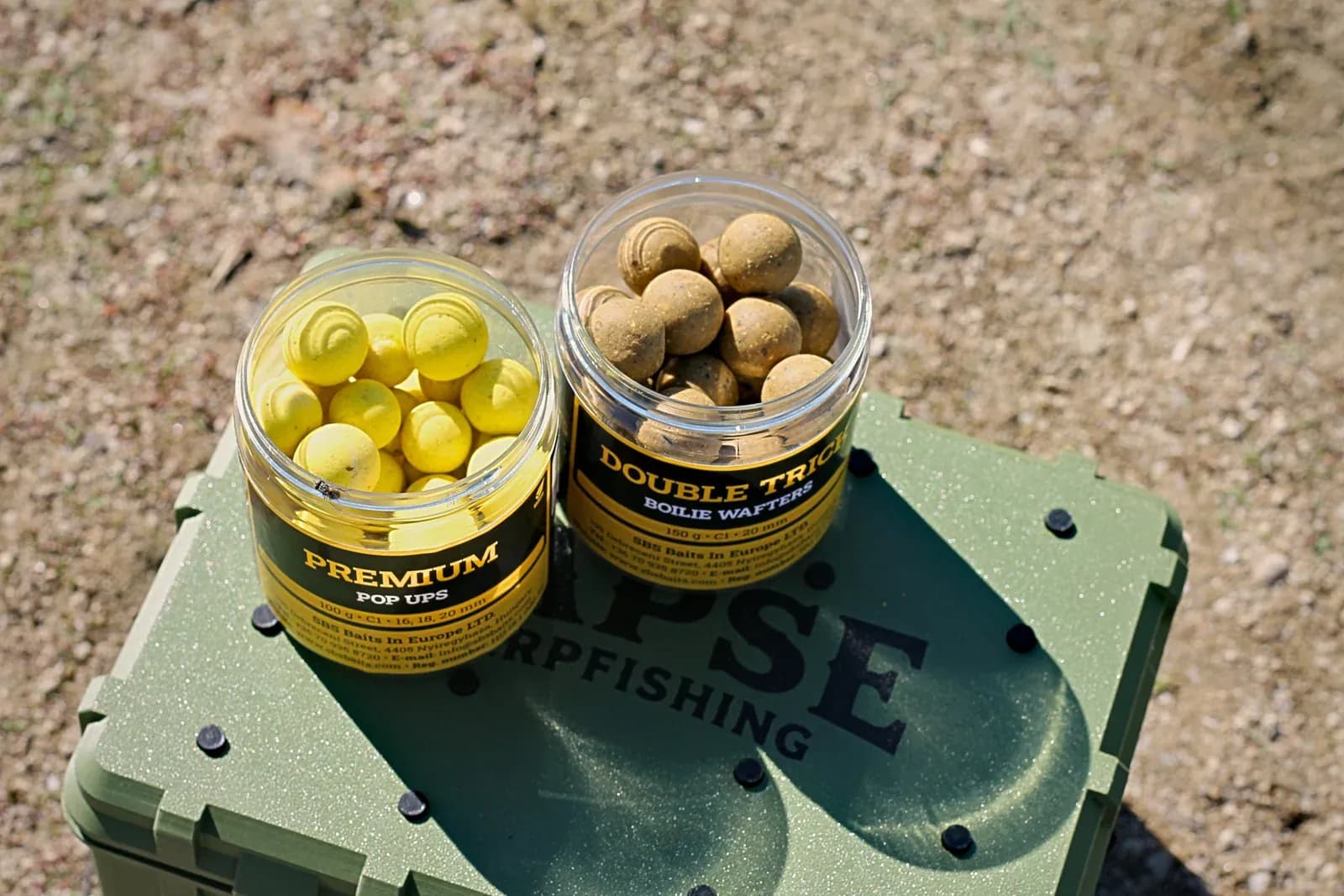
Pop-ups in jars, on the Capse box.
Always balance at home, with tap water, and fine-tune at the swim with reservoir water: density changes, and a rig that sank in 8 seconds at home can float in real water. Carry scissors and counterweights in several sizes.
Pellets
Compressed granules, usually based on fish or vegetable flours. What they attract with: they release oils and attractors very fast and create a dense scent cloud. When to use: as a baiting base in warm water, to generate quick activity, or in PVA bags. When to avoid: in cold water (they saturate without giving sustained attraction), where banned, and in waters with too many small fish. Risk: they dissolve in 1–3 hours; a baiting made only of pellets can leave the zone empty just as the fish arrive.
Sweetcorn
The quintessential Spanish bait and, in many cases, the only legal one. What it attracts with: sugars, visible colour and soft texture; carp recognise it in almost every water.
When to use it: whenever you want quick activity; in spring and autumn; in waters where boilies are banned; for small and medium fish. When to avoid it: with heavy bleak or crayfish presence; when trying to select big specimens.
How to present it: 2–4 grains on the hair, or one grain of fake corn alongside real grains to keep the presentation once small fish have cleaned the rest. Amount: corn is cheap, and that tempts you to overdo it. A well-placed handful outperforms a scattered kilo.
Tiger nuts
A tuber high in sugars and oils, historically strongly associated with catching big carp.
Health and handling warning, important: tiger nuts must be properly soaked and boiled before use. Dry tiger nuts swell inside the fish; a poorly prepared one can cause digestive harm. Usual procedure: soak for 24 h, boil for 20–30 minutes until soft, and let the cooking water ferment for 24–48 h. Never use raw or dry tiger nuts. For this reason, some managed waters ban them outright: check.
When they stand out: warm water and pressured waters where boilies are overused. When to avoid: cold water (digestion is slow), waters where they're banned, and if you can't prepare them properly. Quantity: very little. Tiger nuts are filling; excessive baiting kills the zone.
Particles (chickpea, hemp, lupin, wheat)
What they attract with: they create a carpet of small food that keeps a fish rooting around the bottom for a long time, rather than eating and leaving. Hemp is especially effective in this role.
Mandatory preparation: like tiger nuts, all dry particles must be soaked and boiled. Not optional. When to use them: long sessions in warm water; when you want to hold fish in the zone. When to avoid them: cold water; short sessions; when targeting a single large fish — particles attract and hold medium-sized ones. Risk: high risk of overfeeding, and practically: on a soft bottom small particles bury themselves and become inaccessible.
Bread, pastes and groundbait
Bread: an underrated, very effective bait for surface and margin fishing, where legal. It breaks down fast, which is a virtue (doesn't saturate) and a flaw (doesn't hold).
Pastes and putties: let you wrap the hookbait in a layer that dissolves, releasing attractor right over the rig. Legal note: some regulations — Madrid in trout areas, among others — expressly ban pastes and putties.
Groundbait: powder mixes that create a cloud and draw fish in. Very useful in short sessions, not very advisable over 48 h because they add nothing lasting. In many regions only materials "of plant origin that aren't harmful or polluting" are allowed.
PVA
Water-soluble material (bags, mesh, string) that lets you deposit a small amount of bait exactly on the rig. It's the tool that resolves the contradiction between "I want attraction next to the bait" and "I don't want to bait the whole zone".
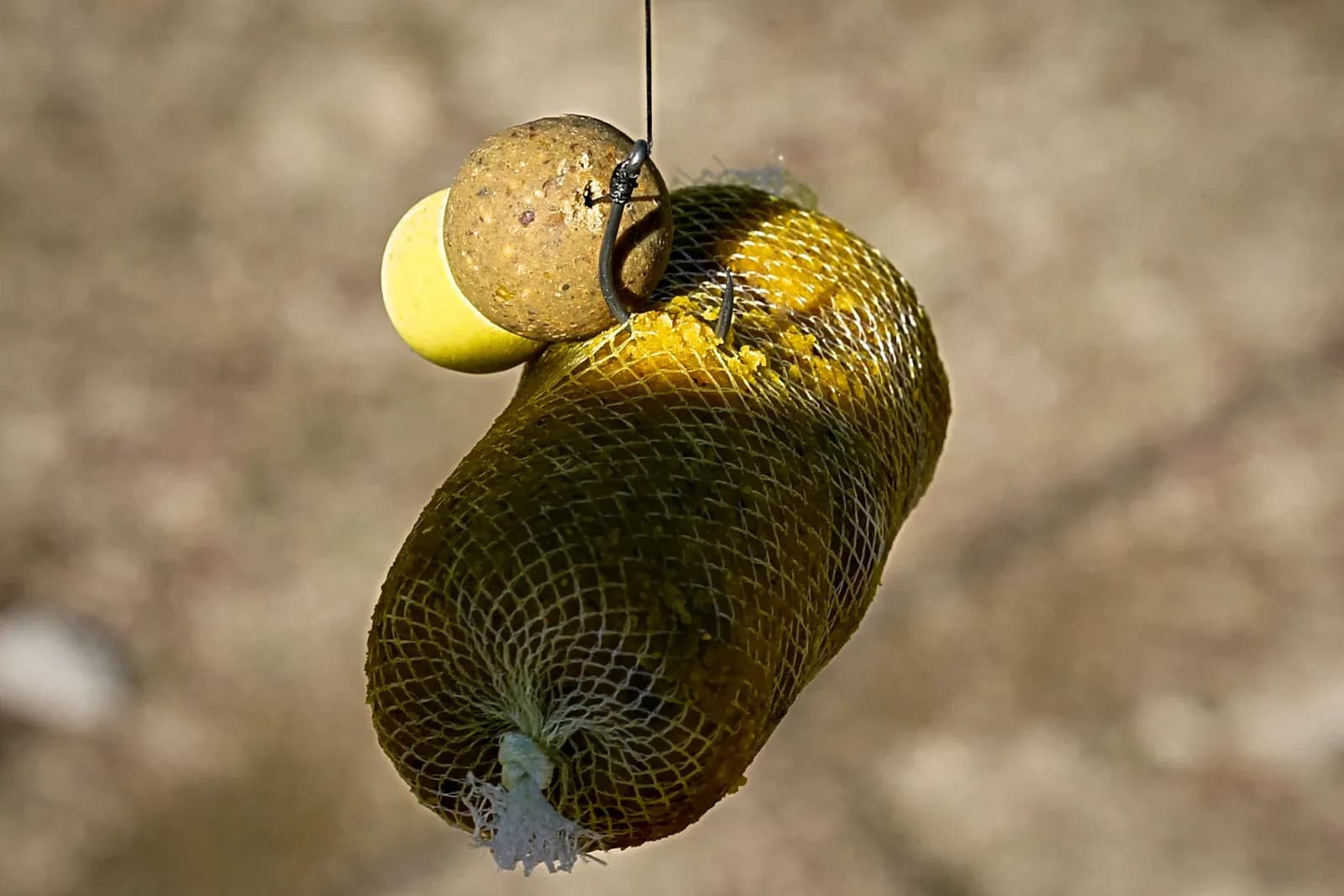
PVA bag tied on the hook.
- Solid bag: filled with crushed pellets or boilies, with the rig inside. Maximum precision; also prevents tangles on the cast.
- Stick or mesh: a compact cylinder threaded on the hook length. Smaller volume, ideal in winter.
Common mistakes: using wet or oily bait that dissolves the PVA before the cast; making bags too big to sink; not purging the air from the bag (it floats and opens away from the spot).
Mind the regulations
PVA deposits bait in the water. Where baiting is banned, using PVA with bait counts as baiting. It's not a loophole; it's the same action in different packaging.
Bait summary table
- Fishmeal boilie: works somewhat in cold water, very well in warm water. High selectivity, medium risk of overfeeding. The summer standard; check its legality.
- Fruit/creamy boilie: works well in cold, some in warm. High selectivity, low risk. A soluble profile for a low metabolism.
- Pop-up: works very well in cold and warm. Medium selectivity, zero risk of overfeeding. A single visible bait, doesn't feed.
- Wafter: works well in cold and warm. High selectivity, zero risk. The best all-round compromise.
- Pellet: works little in cold, very well in warm. Low selectivity, high risk. Dissolves fast; use with a solid base.
- Sweetcorn: works some in cold, very well in warm. Low selectivity, medium risk. Legal almost everywhere, attracts everything.
- Tiger nuts: works little in cold, very well in warm. High selectivity, very high risk. Mandatory preparation, very small quantity.
- Particles: works little in cold, very well in warm. Low selectivity, very high risk. Holds fish, but attracts medium-sized ones.
- Bread: works some in cold and warm. Low selectivity, zero risk. Surface and margins, very underused.
Baiting
The question isn't "how much bait do I put in", but "how much food can the fish population in front of me consume today". They're different questions, and only one has an answer.
First: can you bait here at all? Baiting isn't allowed by default in Spain. Three verifiable examples: in Castilla-La Mancha, baiting before or during fishing is banned in general, with exceptions only in non-trout reservoirs and their diversion channels, and only with non-harmful plant materials plus maggot. In Aragón, baiting can only be done during official competitions and their training sessions, in specific venues and reserves, by federated anglers with a responsible-baiting declaration, up to a maximum of 17 litres or 6 kg dry weight per angler per day during training, only from the bank and without marker buoys. In Extremadura, prior baiting is authorised as long as non-toxic products are used. Before anything else, answer this question for the water you're going to fish.
Types of baiting and what each is for
- Pre-baiting (days ahead): creates a habit — the fish learn there's food at that spot at that time. For planned 48–72 h sessions, on regularly fished waters. Requires it to be legal and that nobody else fishes that spot.
- Mass baiting: a large volume all at once, to hold a large group of fish. Summer, waters with a high population, long sessions. Almost never outside those conditions.
- Reduced baiting: a handful, just to mark the spot. Winter, short sessions, wary fish. The most common case in Spain.
- Precision baiting: everything within a 1–2 m radius around the rig. When the population is scarce and you want the first fish that arrives to find your bait first.
- Spread baiting: scattered over a wide area. When you want fish to search and stay longer; with pressured fish that distrust dense carpets.
- Baiting during the session: topping up based on what happens. After each catch or on detecting activity. Never "by the clock".
- PVA: minimal bait right on the rig. Whenever you want local attraction without baiting the whole zone; the default choice in winter.
The distribution pattern matters as much as the amount: the same quantity of bait produces opposite results depending on how it's spread. Concentrated (≈2 m radius) gives fewer bites but a higher probability per fish that comes in. Spread (10–20 m radius) makes fish search, stay longer and trust it more. In a line, over an observed route, it intercepts rather than draws fish in.
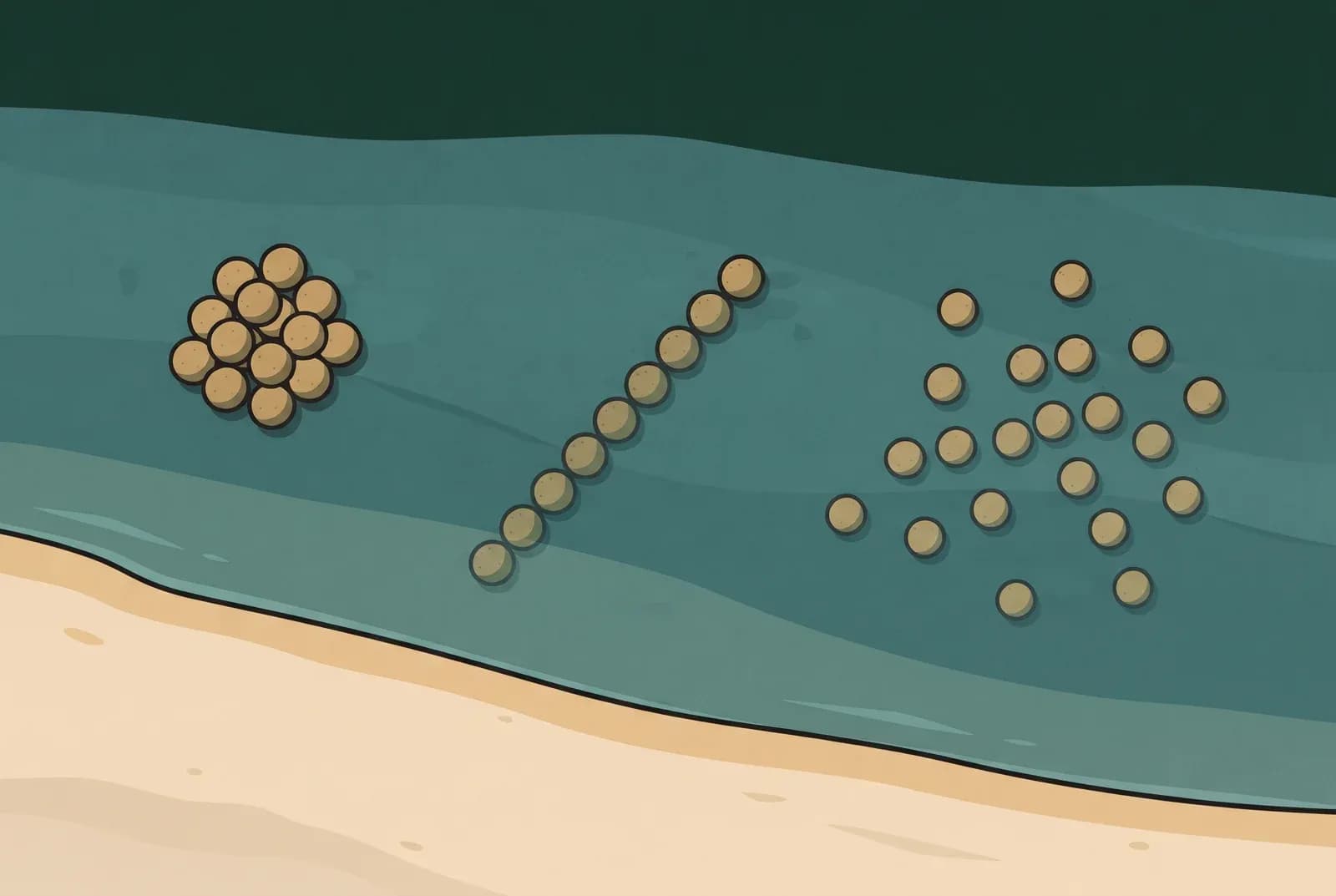
From left to right: concentrated, in a line and scattered.
Decision system: how much to bait?
There's no universal amount, and anyone who offers one is making it up. What can be done is score the variables that determine consumption capacity and translate the score into a baiting level. It's a guideline derived from carp physiology and documented practice: calibrate it with your own experience on your own water.
Step 1 — score seven variables, 0 to 2 points each:
- Water temperature: 0 points if under 10 °C, 1 point between 10–18 °C, 2 points if over 18 °C.
- Observed activity: 0 points with no sign at all, 1 point with isolated jumps or rollers, 2 points with bubbling, disturbed water or visible fish.
- Fish density: 0 points with a scarce or unknown population, 1 point with a medium population, 2 points with a high, known population.
- Session length: 0 points if under 6 h, 1 point between 6–24 h, 2 points if over 24 h.
- Fishing pressure: 0 points if very high (heavily fished swim), 1 point if medium, 2 points if low or none.
- Natural food available: 0 points if abundant (hatches, mussel, weed), 1 point if normal, 2 points if scarce (winter, bare reservoir).
- Bait type: 0 points if very filling (tiger nuts, particles), 1 point if intermediate (corn, fishmeal boilie), 2 points if not very filling (pop-up, soluble bait).
Step 2 — add up and check the baiting level:
- 0–3 points, minimal: just PVA on the rig, or a handful of 10–20 boilies. Nothing else all session except after a catch.
- 4–6 points, reduced: roughly half a kilo spread at the start, concentrated. Top up only after a catch or clear activity.
- 7–9 points, medium: 1–2 kg at the start and a small top-up every time there's a sign. Concentrated or in-line distribution.
- 10–12 points, high: sustained baiting with frequent top-ups. This is where volume makes sense, and only here.
- 13–14 points, very high: mass baiting with a wide spread; keep the carpet alive throughout the session.
Two warnings about this system: the kilo figures are a starting point, not a rule; adjust them to your own water after three or four sessions, noting what you did and what happened. And none of these amounts is valid if your region sets a legal limit: in Aragón, during training, the cap is 17 l or 6 kg dry per angler per day; on other waters the limit is zero. The legal limit always wins.
When to top up, and when to leave it alone
- After each catch: yes, a small amount. The caught fish has taken food from the zone and caused a commotion; topping up restores the spot.
- When you see activity over the baited spot: no. Launching a spomb over fish that are feeding scatters them. Wait.
- Before the activity peak: yes. If you expect activity at dusk, top up mid-afternoon.
- After eight hours with nothing: don't add more bait. If the previous bait hasn't attracted anything, more won't either. It's time to move, not to bait.
Common mistake: baiting out of anxiety. The typical sequence: no bites → "must be short of bait" → top up → still no bites → top up again. By the end of the night there's 8 kg of food on the bottom, any fish that might arrive fills up on the loose offerings, and your rig is one among thousands. More bait is almost never the answer to a lack of bites.
This is the fourth part of a series based on the CapseMaster manual, 2026 edition. Fishing regulations change every season: this content does not replace the closed-season order currently in force in your region.
The whole CapseMaster series
- 1. What carpfishing is and carp biology, applied
- 2. Finding and reading carp
- 3. Gear and the rig catalogue
- 4. Baits and baiting
- 5. Nine complete strategies and fishing by season
- 6. Condition matrix, Spanish scenarios and session protocols
- 7. Big specimens, 50 mistakes and diagnosing at the swim
- 8. Fish care
- 9. Spanish carpfishing regulations
- 10. What to bring, 10-minute field guide, glossary and sources