
Gear and the rig catalogue (3/10)
Third instalment of the CapseMaster series: which gear is truly essential and which is optional, and the full rig catalogue — hair rig, blowback, Ronnie, chod, snowman, wafter, zig and more — with when to use each one.
Third part of the CapseMaster series: what gear you actually need, and the full rig catalogue with when to use each one.
The gear: what you really need
You can catch big carp with modest gear. What you can't do is return them in good condition without the right landing gear. There's no room to cut corners there.
Classified by priority
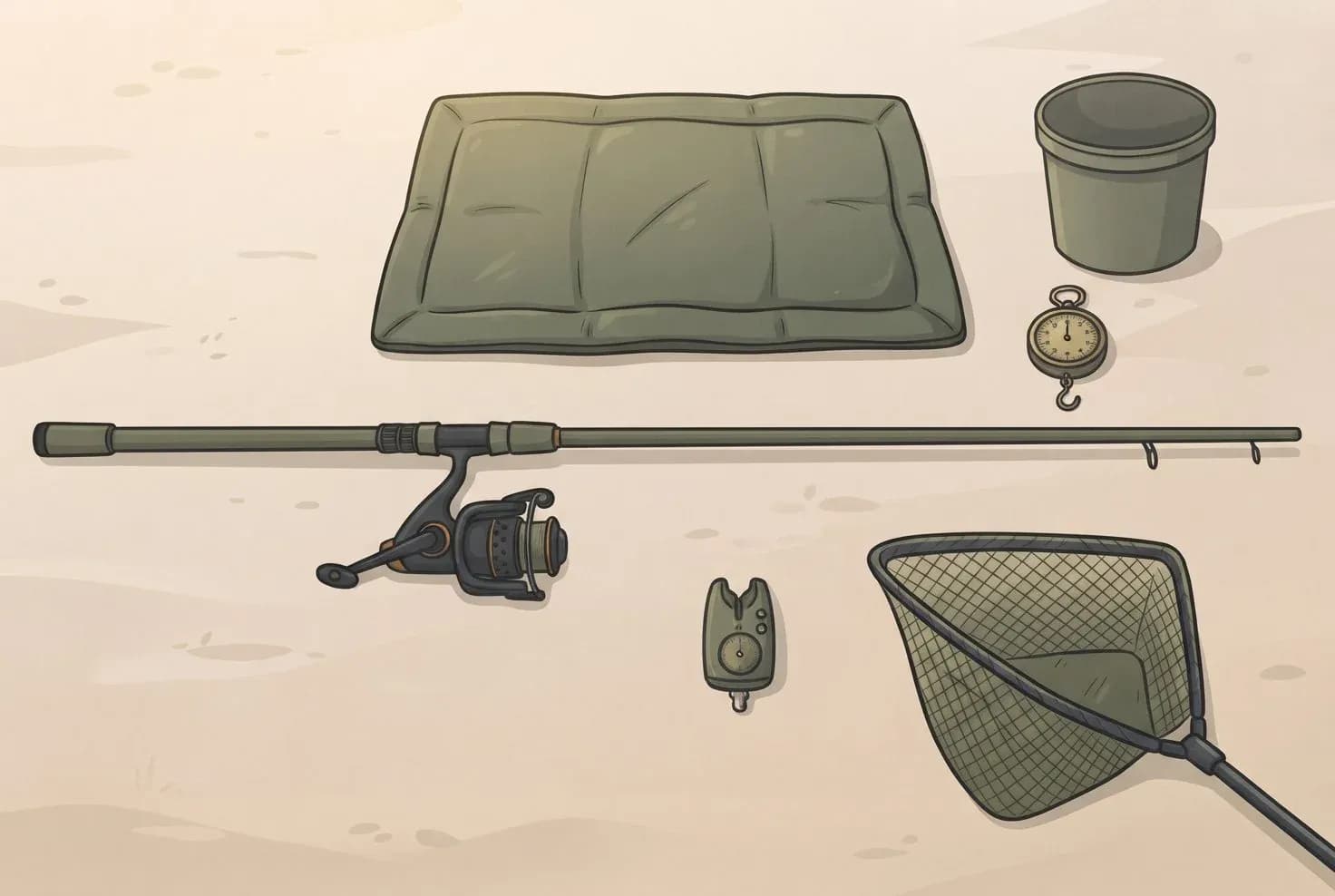
Essential
- Rod: 3.60–3.90 m, 2.75–3.25 lb test for general use. 3.00–3.50 lb test for long-range fishing or in rivers with 120–170 g leads. Progressive action: protects the leader during the short fight under the tip.
- Reel: size 8000–10000 with a fighting drag or a free-spool (baitrunner) system. Minimum capacity 250 m of 0.30 mm. More in rivers with catfish.
- Main line: 0.30–0.35 mm monofilament for general use, its stretch cushions and forgives mistakes. Braid only if you need long-range feel and know how to work the drag.
- Hooks: sizes 4 to 8 cover almost everything. Wide gape or curve shank depending on the rig. Carry triple what you think you'll need.
- Leads: 90–140 g on reservoirs; up to 170 g in rivers with current. Lead is banned in Catalonia's continental waters: use tungsten, steel or bismuth there.
- Landing net: 100–107 cm arms, soft-knot mesh. Not optional: several regions expressly recommend or require it to minimise harm.
- Unhooking mat: padded, with raised sides. A fish that flips off a flat mat onto gravel gets hurt.
- Unhooking tool / forceps: explicitly recommended by good-practice guidelines to release fish without damaging gills or belly.
- Bucket of water: to wet the mat, hands and fish. The most common summer damage comes from dry handling.
Highly recommended
- Leader / shock leader: a stronger final section (0.50–0.60 mm or braided taper) that absorbs abrasion and casting stress with a heavy lead. Mandatory on rocky bottoms.
- Antiseptic: for hook wounds or scrapes. Apply with the fish on the wet mat, not in the water.
- Alarms and indicators: let you watch several rods and catch liners. On an authorised night session, essential in practice.
- Rod pod or sticks: sticks if the ground allows (more stable, less visible); a pod on concrete or rock.
Optional
- Scale and weigh sling: only if you're going to weigh. Weighing costs time out of the water: decide if it's worth it before lifting the fish.
- Marker float: very useful where allowed. Banned as a baiting marker in Aragón.
- Spomb / spod: only makes sense where baiting is authorised.
- Catapult: light, precise baiting at short and medium range. More discreet than a spomb.
Advanced
- Sounder: huge time-saver. Check navigation restrictions and the disinfection requirement.
- Bait boat: careful — in Aragón baiting from any boat, crewed or not, is banned. Other regions restrict it too; don't buy one assuming you'll be able to use it.
- Shelter (bivvy): in Extremadura, in free-schedule stretches, the shelter must be earthy brown or khaki, under 4 m across, with a mosquito-net entrance that lets you see the whole interior from outside. A regular tent counts as free camping.
The four small accessories that decide sessions
- Baiting needles (a fine needle, a boilie needle and a splicing needle for braid): without them you can't tie a decent hair in the field.
- Boilie stops: plastic or dried grass. Carry spares, they're the first thing you lose at night.
- Anti-tangle tubing and rubber sleeves: reduce tangles and help the leader settle on the bottom the way you intended.
- Head torch with a red light: preserves your night vision and disturbs shallow water much less. A white torch pointed at the water at three in the morning is a classic mistake.
On a tight budget, spend in this order: first, all the fish care and landing gear (net, mat, unhooking tool, bucket) — it's what you can't improvise and where the fish pays for your cuts. Second, a decent reel with a reliable drag. Third, new line. The rod is where a cheaper purchase costs least: a budget 3.00 lb rod, well used, catches exactly the same fish as an expensive one.
The rig catalogue
No rig is universally better. Each solves a specific problem: a type of bottom, a type of bait or a type of fish. If you don't know what problem it solves, don't use it.
The three components that define any rig
Before the catalogue, it's worth separating three decisions that often get confused:
- The lead system (how the lead attaches to the line): determines the self-hooking effect and the fish's safety if the line breaks.
- The hook length (material, length, stiffness): determines how the whole thing behaves as the fish sucks it in.
- The bait presentation (sunk, neutral or floating; at what height): determines whether the bait reaches the mouth.
A "chod rig" is, in fact, the combination of a helicopter system + a short stiff hook length + a pop-up. Understanding the pieces separately lets you build new solutions instead of memorising names.
Non-negotiable fish-safety rule: if the main line breaks with a fish hooked, the rig has to free itself. A fixed lead attached to a hook length that won't release condemns the fish to drag it until it dies. Always check, on dry land, that you can pull the hook length free and that the lead detaches or the hook length releases from the leader. It's the single most important check on the whole rig, and the one fewest people make.
The three lead systems:
- Inline lead: the line runs through the lead. Maximum weight transmission, a very direct self-hooking effect. Good on hard, clean bottoms; risk if the lead doesn't release.
- Lead clip: the lead detaches from the clip under tension and stays on the bottom. Good for weed, obstacles and safety; the downside is losing leads (cost and litter).
- Helicopter: the hook length spins freely on the leader and sits above the sunken lead. Good for deep silt and unknown bottoms; less effective at long range if the stop isn't set correctly.
The hair rig and the knotless knot: the base of everything
The knotless knot creates the hair and fixes the hook in a single operation: you make 7–9 tight turns around the shank, and the key is that the tag end re-enters through the same side of the eye the hair came out of, so the line exits aligned with the shank and the hook can turn correctly.
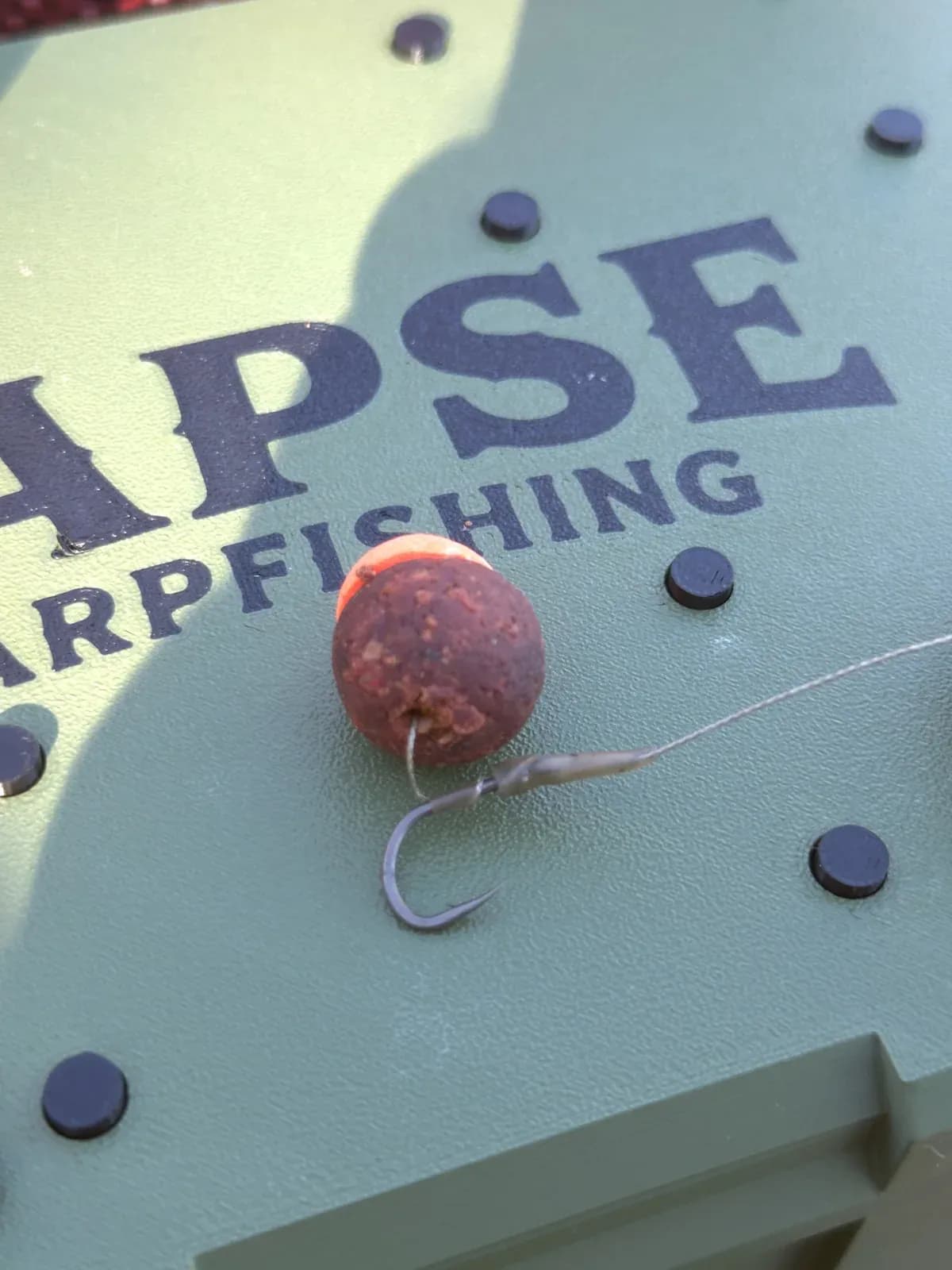
Hair rig: the bait sits on the hair, separate from the hook.
Fact sheet · Hair rig - What it's for: presenting the bait separated from the hook, so the hook goes in free and can turn to catch the bottom lip. - Bottom: any, with the right lead system. - Bait: boilie, sweetcorn, tiger nuts, pellet, snowman. Practically all of them. - Ideal situation: the default starting point. Clean, hard bottom, sunk bait. - Material: 20–25 lb soft or coated braid; wide gape hook, size 6–8; boilie stops. - Hook length: 15–22 cm is the usual working range. Shorter speeds up the hook-set; longer gives naturalness and helps over silt. - Hair length: the bait should sit 2–5 mm from the hook bend. Adjust to bait size: bigger bait, slightly longer hair. - Common mistakes: hair too long (the fish takes the bait without the hook); misaligned eye; using a blunt hook; a stop too big that stops the bait moving. - Advantages: simple, cheap, universal, easy to tie at night with cold hands. - Disadvantages: sensitive to bait position on soft ground; less effective than the Ronnie with pop-ups. - When not to use it: deep silt without adjustments; dense weed; when you want a high floating presentation.
Fact sheet · Blowback rig
What it solves: on the classic hair rig, when the fish expels the bait, the bait can drag the hook backward and block the turn. The blowback adds a sliding ring or rubber sleeve the hair passes through, mounted on the shank: the bait can slide back, leaving the hook free to turn.
Bottom: hard or clean. Bait: sunk boilie or wafter. Hook length: 18–20 cm of coated braid with the hook-end skinned back. Advantage: noticeably improves the hook-up ratio over a simple hair with fish that expel quickly. Disadvantage: one more part that can fail; a badly sized sleeve chokes the turn instead of helping it. Not for use with high pop-ups, where the Ronnie does a better job.
Pop-up rigs
Fact sheet · Ronnie / Spinner rig
What it solves: maximising the hook's freedom to turn with a low pop-up, mounted on a rotating swivel. Bottom: hard, clean, or very light silt. Depth: any. Hook length: short, 10–15 cm, coated or soft braid. Material: curve shank hook size 4–6, hook swivel, curved rubber sleeve, kicker, 12–16 mm pop-up, tungsten counterweight.
How to tie it: (1) mount the swivel on the hook with the sleeve; (2) attach the swivel to the hook length; (3) mount the pop-up on the hair with a ring or directly on the swivel's hair; (4) balance it in a glass of water until it sinks very slowly. Common mistakes: not balancing the pop-up (the most common, and it ruins the rig); a sleeve too stiff, blocking the turn; a pop-up too buoyant, lifting the whole hook length. Not for use on deep silt (use a chod or helicopter instead) or with large sunk baits.
Fact sheet · Chod rig
What it solves: presenting correctly without knowing the bottom. As the hook length runs on the leader between two stops, if the lead sinks into silt or weed, the hook length rises and the pop-up ends up presented above it. Bottom: silt, low weed, mixed or unknown bottom. Bait: 12–15 mm pop-up. Hook length: very short (5–8 cm) and stiff, with a characteristic curve; the stiffness is functional, it maintains the gap between hook and bait.
Common mistakes: stops too close together (the hook length can't rise); using it on a clean, hard bottom, where it performs worse than a Ronnie; a bait that's too buoyant. Real downside: being short and stiff, some fish detect it with their barbels; in very pressured waters it can be counterproductive.
Fact sheet · Hinged stiff rig
A variant of the chod with two sections: a short stiff section for the hook and a braided section acting as a hinge. What it solves: combines the chod's guaranteed presentation with more natural bait movement. When: high pop-ups over silt, in waters where a "pure" chod has stopped working. Downside: a complex rig, hard to repair at night on the bank.
Fact sheet · Multi rig
What it solves: lets you change the hook without redoing the hook length, thanks to a loop the hook clips onto. Very useful when fishing abrasive bottoms and having to renew the point often. Semi-stiff hook length, 12–18 cm, with a pop-up. Downside: the loop must be tied well or the hook comes off during the fight. Don't use it if you don't know the knot well.
Fact sheet · D-rig
What it solves: the bait is mounted on a "D" of stiff material that runs along the shank, giving the bait freedom of movement on two axes and making it harder for the fish to expel it cleanly. Bait: pop-up or wafter. Bottom: hard. When: wary fish in clear water. Downside: more fiddly; a badly sized D blocks the bait.
Fact sheet · Combi rig
What it solves: joins a stiff section next to the hook (avoids tangles and holds the presentation) with a soft section toward the lead (natural movement, the fish doesn't feel stiffness as it takes the bait). Bottom: hard or slightly soft. Bait: sunk or wafter. Length: 18–25 cm, with the stiff section around a third of it. Probably the most underrated rig for Spanish reservoirs: resistant, versatile and less "seen" by fish than the chod.
Presentation by bait buoyancy
Fact sheet · Snowman
What it solves: reduces the apparent weight of the bait+hook combo without giving up the sunk boilie. A sunk boilie below and a smaller pop-up above. When: light silt bottom, cold water (visibility), or when you want a bait that goes in with very little suction. Critical adjustment: the combo must sink slowly, not float. Don't use with heavy bleak presence — the small pop-up is the first thing that disappears.
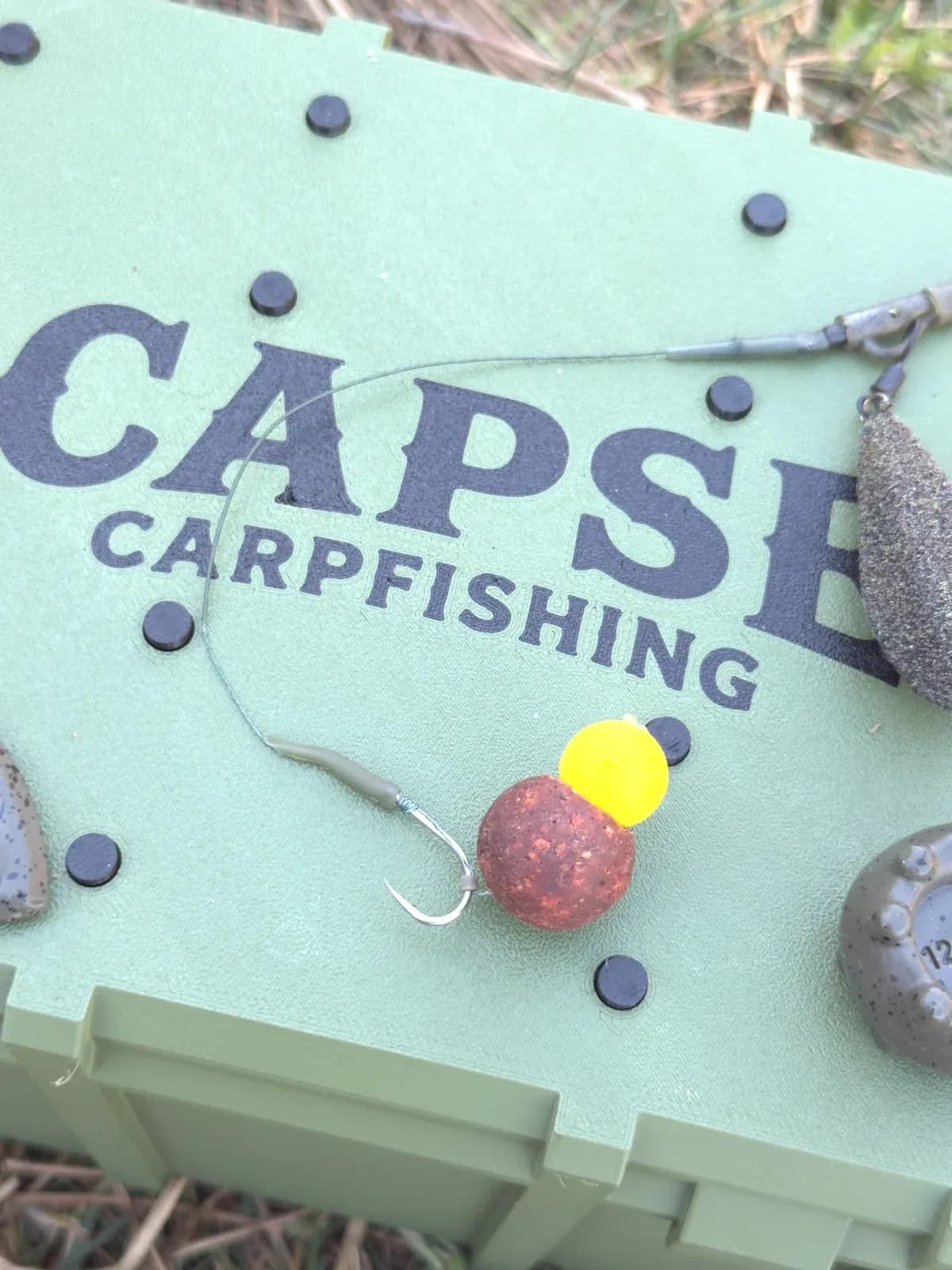
Snowman: a boilie topped with a pop-up.
Fact sheet · Wafter rig
What it solves: near-neutral buoyancy presentation over a clean bottom, with the bait resting but weightless. Tied like a normal hair rig. If you had to pick a single presentation for a Spanish reservoir with an unknown but reasonably clean bottom, a wafter on a combi rig is the bet with the best simplicity-to-effectiveness ratio.
Fact sheet · Zig rig
What it solves: when carp aren't on the bottom. In summer, with a thermocline, or with fish basking, the bottom can be empty while fish sit 2 m deep over 8 m of water. How: a long, thin monofilament hook length (1 to 10 m) with a small foam or rubber bait; the hook-length length determines the fishing depth.
Working method: start at mid-water. If there's no response in 2–3 hours, go 1 m up or down. With three rods, cover three different depths. Common mistakes: casting a zig like a bottom rig (it tangles); using too big a bait; never changing the depth. Legality: zig bait is usually foam or rubber, i.e. artificial bait; check whether your region allows it in cyprinid waters — some rules restrict to natural, plant-based baits in certain stretches.
Rigs for difficult bottoms
Soft bottom (silt, mud). The problem: the lead sinks and drags the hook length; the bait ends up buried and the fish can't find it. Four solutions: a helicopter system with a high stop, so the hook length sits above the sunken lead; a chod rig, for the same reason, with the advantage of guaranteed presentation; a longer hook length (25–30 cm) and a lighter lead than usual, accepting a somewhat weaker self-hooking effect; or a pop-up/snowman so the bait sits above the soft layer.
Expert tip: not all silt is the same. Dark silt, smelling of rotten egg with gas bubbles, is anoxic: fish don't feed there and no rig fixes that. Light, clean silt the lead passes through without resistance and with no smell is full of chironomid larvae and is one of the best feeding zones there is. The lead will tell you which one you've got: smell it when you reel it in.
Weed. The problem: the bait disappears inside the weed bed and a hooked fish tangles. Presentation: a high pop-up (chod or helicopter) above the canopy, or find clear patches and present in them. Lead system: an easy-release lead clip, so the fish doesn't drag weight through the plants. Hook length: abrasion-resistant, short to reduce tangles. Drag: tighter than usual, to lift the fish's head from the first second — one of the few situations where you don't let it run.
Master rig-selection table
- General, known bottom (hard, clean, sunk boilie): hair rig + blowback with an inline lead; alternative, combi rig. Reason: maximum weight transmission and a direct hook-set.
- Light silt (soft, wafter): combi rig with a 22–25 cm hook length; alternative, snowman. Reason: the long hook length lets the bait sit above the soft layer.
- Deep silt (very soft, pop-up): chod rig on the leader; alternative, helicopter + short hook length. Reason: the presentation doesn't depend on where the lead ends up.
- Unknown bottom (mixed, pop-up): chod rig; alternative, helicopter. Reason: it's the only option that presents well on any bottom.
- Weed (algae/weed, 15 mm pop-up): helicopter + lead clip; alternative, chod. Reason: bait over the canopy, a lead that releases when it snags.
- Fish high in the water (irrelevant, foam/rubber): zig rig; alternative, surface fishing where legal. Reason: the bait is brought to the fish, not the other way round.
- High fishing pressure (hard, an uncommon bait for the water): D-rig or combi with a long hook length; alternative, Ronnie with a small pop-up. Reason: a less "seen" presentation, more bait movement.
- Big, wary carp (hard/mixed, wafter or snowman): 22–25 cm combi rig; alternative, hinged stiff. Reason: naturalness in the soft section, reliable presentation in the stiff one.
- River with current (gravel/sand, hard boilie): hair rig, 110–170 g inline lead; alternative, short combi. Reason: holds against the current and a clean hook-set.
- Obstacles and trees (variable, boilie): lead clip + short resistant hook length; alternative, helicopter. Reason: lifting the fish's head immediately and releasing the lead.
- Cold water, under 10 °C (hard, bright 12 mm pop-up): Ronnie, minimal baiting; alternative, chod. Reason: a single, visible bait with no competing food around it.
- Heavy bleak presence (any, hard boilie 18 mm or more): hair rig, big bait; alternative, tiger nuts. Reason: a bait small fish can't destroy.
Common mistake: changing the rig when there are no bites. In the vast majority of cases, no bites means there are no fish over the bait, not that the rig is wrong. Only change the rig if you have positive evidence — liners, bubbling over the zone, other anglers catching nearby — that there are fish there and they're not taking it. Without that evidence, it's a location problem.
This is the third part of a series based on the CapseMaster manual, 2026 edition. Fishing regulations change every season: this content does not replace the closed-season order currently in force in your region.
The whole CapseMaster series
- 1. What carpfishing is and carp biology, applied
- 2. Finding and reading carp
- 3. Gear and the rig catalogue
- 4. Baits and baiting
- 5. Nine complete strategies and fishing by season
- 6. Condition matrix, Spanish scenarios and session protocols
- 7. Big specimens, 50 mistakes and diagnosing at the swim
- 8. Fish care
- 9. Spanish carpfishing regulations
- 10. What to bring, 10-minute field guide, glossary and sources