
What carpfishing is and carp biology, applied (1/10)
What carpfishing is and carp biology, applied (1/10)
This is the first part of a nine-part series adapting the CapseMaster manual for the blog: a technical reference on carpfishing biology, rigs, baits, strategy and Spanish regulations.
What carpfishing is, and what sets it apart
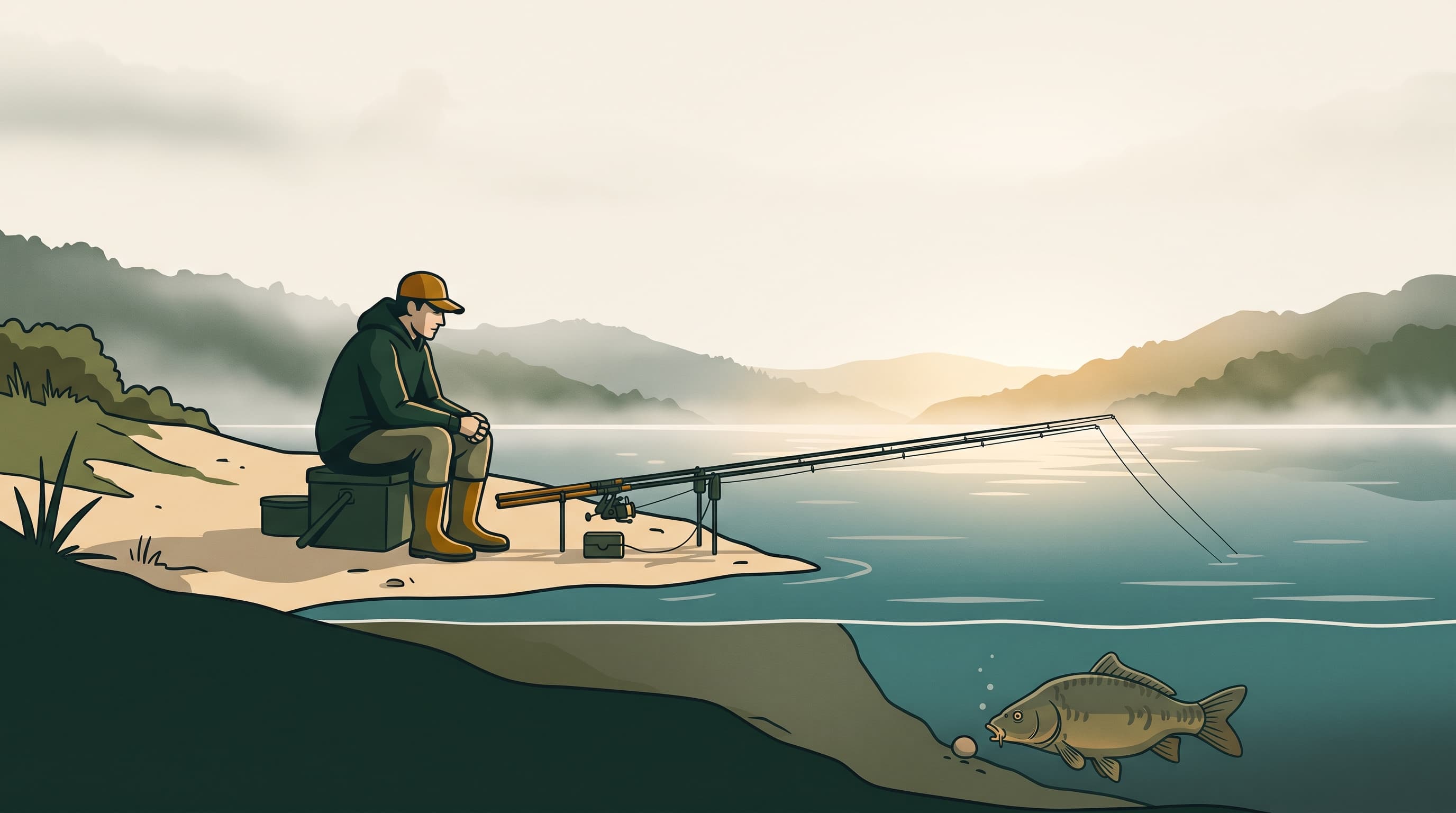
It isn't just "fishing for carp". It's a static, long-range fishing system with a selected bait and a self-hooking presentation, designed for large fish that examine their food before swallowing it.
The working definition
Modern carpfishing is defined by four decisions taken together:
- A bait selected for size and hardness, usually a boilie (a boiled paste ball) large and firm enough that small fish can't pull it off the hook.
- A presentation separated from the hook, via a hair, so the hook itself stays free and can turn to set.
- A heavy, fixed or semi-fixed lead, which turns the fish's own rejection movement into the hook-set: the bolt rig, or self-hooking effect.
- Baiting the swim: building a feeding area instead of waiting for the fish to pass in front of the bait.
Remove any one of the four and it stops being carpfishing and becomes something else, equally valid, but with different rules. In Spain this distinction matters a lot, because baiting is banned or heavily restricted in several autonomous communities, which forces the system to be adapted rather than copied.
Where it comes from, and why it looks so little like traditional fishing
Carpfishing was born in the UK in the second half of the 20th century, on small, closed lakes with known fish populations — fish with names, caught and released dozens of times. All the gear is designed for that context: progressive-action, low-test rods for long casts with 90–140 g leads, acoustic alarms to watch two or three rods over 48 hours, long-armed landing nets, unhooking mats, weigh slings.
The Spanish scenario is nearly the opposite: large reservoirs that swing in level, with abundant but scattered populations, and rivers with current. Many British techniques still work, but the priorities change: on a 3-hectare English lake the question is "which presentation"; on a 5,000-hectare Extremaduran reservoir the question is "where".
Expert tip: if you come from traditional bottom fishing, the hardest mental shift isn't the gear — it's accepting that you can go ten hours without touching the rods and still be fishing well, and that you can pack up and move spot three times in one morning and be fishing even better. Carpfishing rewards patience on a good spot and punishes patience on a bad one. Telling the two apart is the central skill.
The species you'll actually meet in Spain
Besides common carp and its varieties (royal or mirror, leather, and fully scaled carp), almost any Spanish session includes barbel (several native species of the genus Luciobarbus, often with mandatory catch-and-release or a bag limit), roach-like boga, crucian carp, bleak — a plague for small baits — and, in the Ebro and Tagus basins, wels catfish. This has three practical consequences:
- A leader built only for carp may lack the strength if it hooks a catfish.
- Barbel take the same baits, and in many communities they cannot be killed or even handled; their legal status differs from carp's. Prepare the landing set-up so you can release it unharmed.
- Bleak destroy soft particles and pastes within minutes in summer. Boilie hardness isn't a cosmetic choice: it's what keeps your bait on the bottom three hours later.
The Spanish problem: carp is a listed invasive species
Carp appears on Spain's Catalogue of Invasive Alien Species (RD 630/2013), reinstated by a 2016 Supreme Court ruling. Law 42/2007, amended by Law 7/2018, introduced article 64 ter and a transitional provision letting the autonomous communities authorise hunting and fishing of these species in delimited zones, where they have social or economic relevance and have occupied those waters since before 2007.
That creates three different regimes coexisting in the same country:
- Release banned (e.g. the Community of Madrid): a captured carp cannot be returned to the water. Classic catch-and-release carpfishing simply isn't legal there.
- Release authorised as an exception (e.g. La Rioja, Castilla y León, Aragón): release is allowed in certain mapped waters or specific cyprinid waters.
- Release mandatory (e.g. certain reserves in Extremadura; waters in Huesca and Zaragoza): in some stretches the carp must be released; taking it home is the offence.
None of the three is "the right one". They're different management decisions about the same ecological problem. What is wrong is assuming one community's regime applies in another: it's the most common cause of fines for carp anglers in Spain. The article on Spanish regulations later in this series covers each case with its source.
Golden regulatory rule: before each trip to a new water, check three things in this order: (1) whether carp is a fishable species there and what you must do with it after landing it; (2) whether baiting is allowed there; (3) whether the schedule permits night fishing. All three can vary within the same province.
The carp: biology applied to fishing
The whole carpfishing system — the hair, the heavy lead, the bait's hardness, the hook size — is an engineering answer to a very specific way of eating. Understanding that way of eating lets you stop copying rigs and start choosing them.
How a carp actually eats
The carp's bucco-pharyngeal apparatus has been studied with cineradiography and electromyography. A carp doesn't "bite": it runs through a sequence of stereotyped patterns — particle suction, pump-swallowing, rinsing, repositioning, selective retention, expulsion, transport, crushing and grinding — combined according to the type of food.
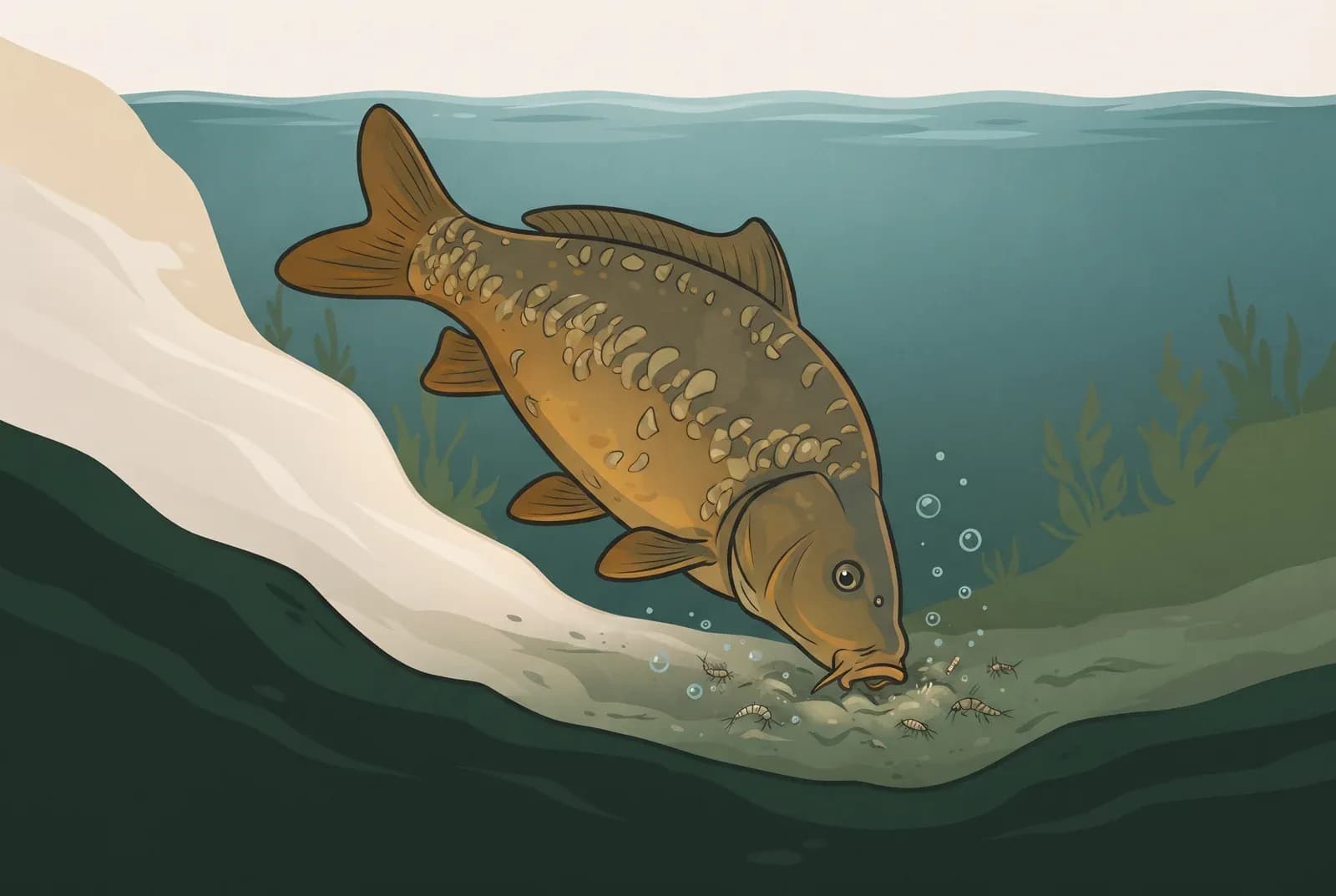
The carp extends its mouth to suck food from the sediment.
Two parts do all the fine work:
- The protractile upper jaw: the carp projects its mouth outward like a tube, generating suction. It can suck up food from the bottom along with silt and gravel.
- The palatal organ (roof of the anterior pharynx) and the postlingual organ (floor): two muscular pads covered in taste buds that sort food from non-food already inside the mouth and eject what doesn't pass.
This is the key to everything. The carp takes in and spits out. It sucks up a patch of bottom, sorts internally, spits out what's useless, retains what's edible and carries it to the pharyngeal teeth — molars located in the throat, not the mouth — where it's crushed against a horny plate before swallowing. Carpfishing is built entirely on that internal-selection step: the fish can eject what it doesn't like before swallowing, and the rig must set the hook right at that moment.
Why the hair works (and why the self-hooking effect exists)
Two problems and their solutions follow from that mechanics:
Problem 1: the hook weighs the bait down. If the hook is embedded inside the boilie, the whole thing behaves differently from the loose bait around it: it's heavier, moves differently when sucked in, and arrives at the mouth metal-first. The hair rig solves this by hanging the bait from a short hair behind the hook's bend. The bait behaves like any other, and the hook goes in free, able to turn and grab the bottom lip.
Problem 2: the carp spits it out. Because rejection is a fast backward movement, the hook-set must happen at that instant, with no human input. The self-hooking effect achieves this with a sufficiently heavy, fixed (or semi-fixed) lead: as the fish moves away with the hook in its mouth, the lead's resistance drives the point home. That's why carpfishing uses 90–140 g leads where other techniques use 20 g.
Expert tip: the practical consequence is that the hook point is everything. A hook whose point has scraped gravel on the previous cast has a fraction of its penetrating power. Test it with your fingernail — it should catch without pressure — before every cast, and change it without hesitation if it doesn't. It's the single best cost-to-benefit action of the whole session.
The senses: what a carp detects, and from how far
- Smell: highly developed nasal sacs; detects dissolved compounds at very low concentrations and follows odour gradients. Soluble attractors work at a distance and in cold water — it's the sense that draws the fish in.
- Taste: taste buds all over the body, lips, barbels and especially inside the mouth. There's a strong taste response to free amino acids, with very different palatability depending on the amino acid. It's the sense that decides swallow or spit — it explains why amino-acid-based attractors (hydrolysates, fishmeals, extracts) perform.
- Touch: four barbels with tactile and taste receptors, exploring the bottom before suction. A stiff leader or a poorly presented anti-tangle tube can be detected before the bait even enters the mouth.
- Lateral line: detects low-frequency vibrations and water displacement. Heavy footsteps on the bank, thumping the ground, and dragging a chair all transmit through it. In shallow water it's a real factor.
- Sight: functional, with colour vision; its usefulness drops with turbidity and depth. Bait colour matters in clear, shallow water; in murky water or at night it's secondary to smell and taste.
- Weberian apparatus: a chain of small bones connecting the swim bladder to the inner ear — cyprinids hear especially well. Silence at the swim isn't superstition.
Common mistake: believing "more smell = more fish". In heavily pressured waters, a bait with the exact same aromatic signature every angler on the reservoir has been using can be a learned danger signal, not a food signal. It's not experimentally proven, but it's consistent with the taste-discrimination ability described above and with the repeated observation that "odd" baits work on burnt-out waters. Treat it as a hypothesis, not a rule.
Temperature: the factor that dominates everything else
Carp are ectotherms: their metabolic rate, and with it their intake, depends directly on water temperature. The published data is consistent:

The same spot in spring, summer, autumn and winter.
- Maximum daily intake in adult carp is reached around 28 °C (≈2.8% of body weight/day); in juveniles the figure is much higher.
- Foraging and growth increase along the thermal gradient and peak between 24 and 28 °C; the optimal growth range is usually 25–30 °C.
- At 14 °C an adult's feeding rate drops to ≈1.2% of body weight/day. At 6 °C carp still feed, but in tiny amounts (≈0.01% of body weight/day).
- Above 34 °C intake drops significantly.
Translated to the bank: between 6 °C and 28 °C, the amount of food an adult fish needs changes by a factor of several hundred. That, not fashion, is why you bait lightly in winter. It's not that carp "don't eat" in the cold; it's that they eat such a tiny amount that a normal baiting-up either fills them up or, worse, leaves uneaten food that adds no attraction.
The daily rhythm: when they eat
Under controlled conditions, across the whole 4–34 °C range, carp show a daily feeding rhythm with two peaks: one from 08:00 to 11:00 and another from 19:00 to 23:00, each accounting for 10–33% of daily intake. When the temperature drops below 10 °C, the peaks shift: the morning one (08:00–11:00) stays, and the second stretches from 19:00 all the way to 04:00.
This is lab data, not reservoir data: in the wild, light, fishing pressure, wind and food availability modulate it. But it gives a useful skeleton:
- Dawn and dusk aren't superstition. They line up with the edges of the two peaks. If you can only fish a few hours, choose the ones that overlap with them.
- In cold water, the long night window makes sense — where the law allows it. Activity doesn't disappear, it stretches out.
- Bait up before the peak, not during. If you expect activity at 19:00, the bait needs to have been on the bottom a while already, not land on top of the fish as they arrive.
Oxygen, light, wind and atmospheric pressure
Oxygen. Carp tolerate low dissolved oxygen far better than salmonids, which lets them occupy warm, eutrophic waters other species can't. In midsummer, in reservoirs with a marked thermocline, the deep layers can be almost anoxic: fishing "as deep as possible" can be exactly the wrong move. Look for areas with water movement — inflows, wind-battered banks, tails with inflow — before depth for its own sake.
Light. Big carp tend to feed with more confidence in low light, especially in clear, pressured waters. In very transparent Spanish reservoirs, captures of large specimens are disproportionately concentrated in the two hours around dawn and at night, where it's legal.
Wind. Warm wind blowing from the bank toward the centre pushes surface water, plankton and warmth toward the opposite bank; fish tend to follow. It's one of the few "rules" of carpfishing with broad agreement across sources. The usual exception is cold, dry winter wind — in Spain, from the continental north and north-west — which can chill the bank it hits and push fish to shelter. Test it on your own water: there isn't enough evidence for a general rule that holds everywhere.
Atmospheric pressure. There isn't enough evidence for a general rule about its effect on carp activity. There's plenty of angler folklore, contradicting itself, and very little applicable research. What is reasonably well established is that rapid weather changes come with changes in wind, temperature and light, which do matter. Attributing to pressure what's probably down to wind is a common interpretation error.
Big fish behave differently
Specialist sources agree that the larger specimens in a water tend to: feed in shorter, less frequent episodes; prefer to feed in low light; stay away from concentrations of medium-sized fish; and show a greater tendency to reject presentations they've already "tried".
The most cited explanation is learning from past experience: a fish caught several times associates specific stimuli with capture. Studies on learning and avoidance in cyprinids support the general plausibility, but the specific mechanism hasn't been demonstrated in wild reservoir carp. Use it as a working framework — change the presentation, change the bait, change the baiting pattern — without turning it into dogma.
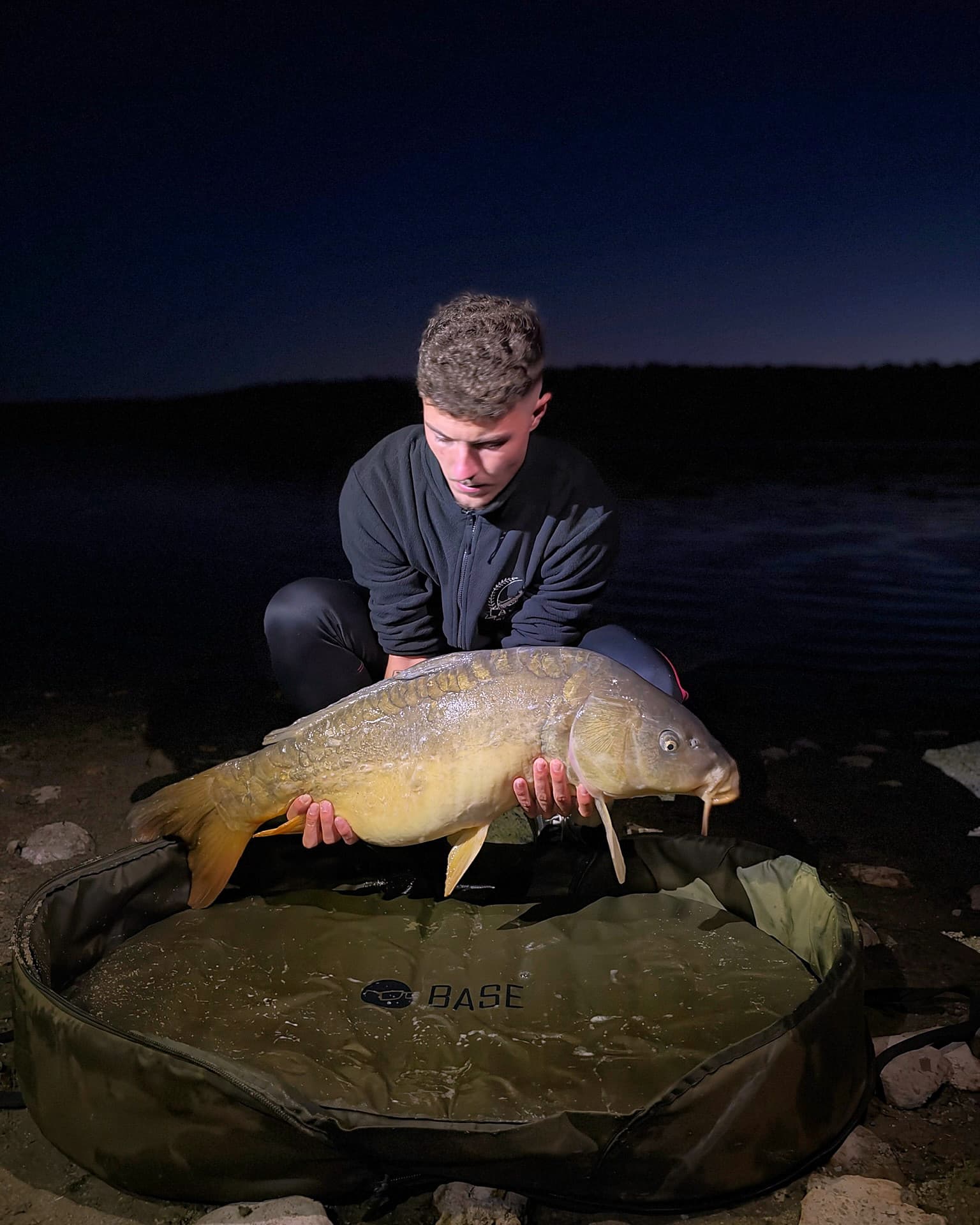
A 9 kg royal carp from Pedrezuela, caught on 21 October 2026.
Expert tip: the most useful practical difference between fishing for "carp" and fishing for "big carp" isn't in the rig — it's in how long you leave the bait in the same spot. A swim that produces 4 kg carp every two hours rarely produces the 15 kg one; often you have to accept twenty hours without a bite over a zone you know the big fish patrols. It's a decision about your goals, and it's better made on arrival than at three in the morning.
This article is the first part of a series based on the CapseMaster manual, 2026 edition. Fishing regulations change every season: this content does not replace the closed-season order currently in force in your region.
The whole CapseMaster series
- 1. What carpfishing is and carp biology, applied
- 2. Finding and reading carp
- 3. Gear and the rig catalogue
- 4. Baits and baiting
- 5. Nine complete strategies and fishing by season
- 6. Condition matrix, Spanish scenarios and session protocols
- 7. Big specimens, 50 mistakes and diagnosing at the swim
- 8. Fish care
- 9. Spanish carpfishing regulations
- 10. What to bring, 10-minute field guide, glossary and sources