
Big specimens, 50 mistakes and diagnosing at the swim (7/10)
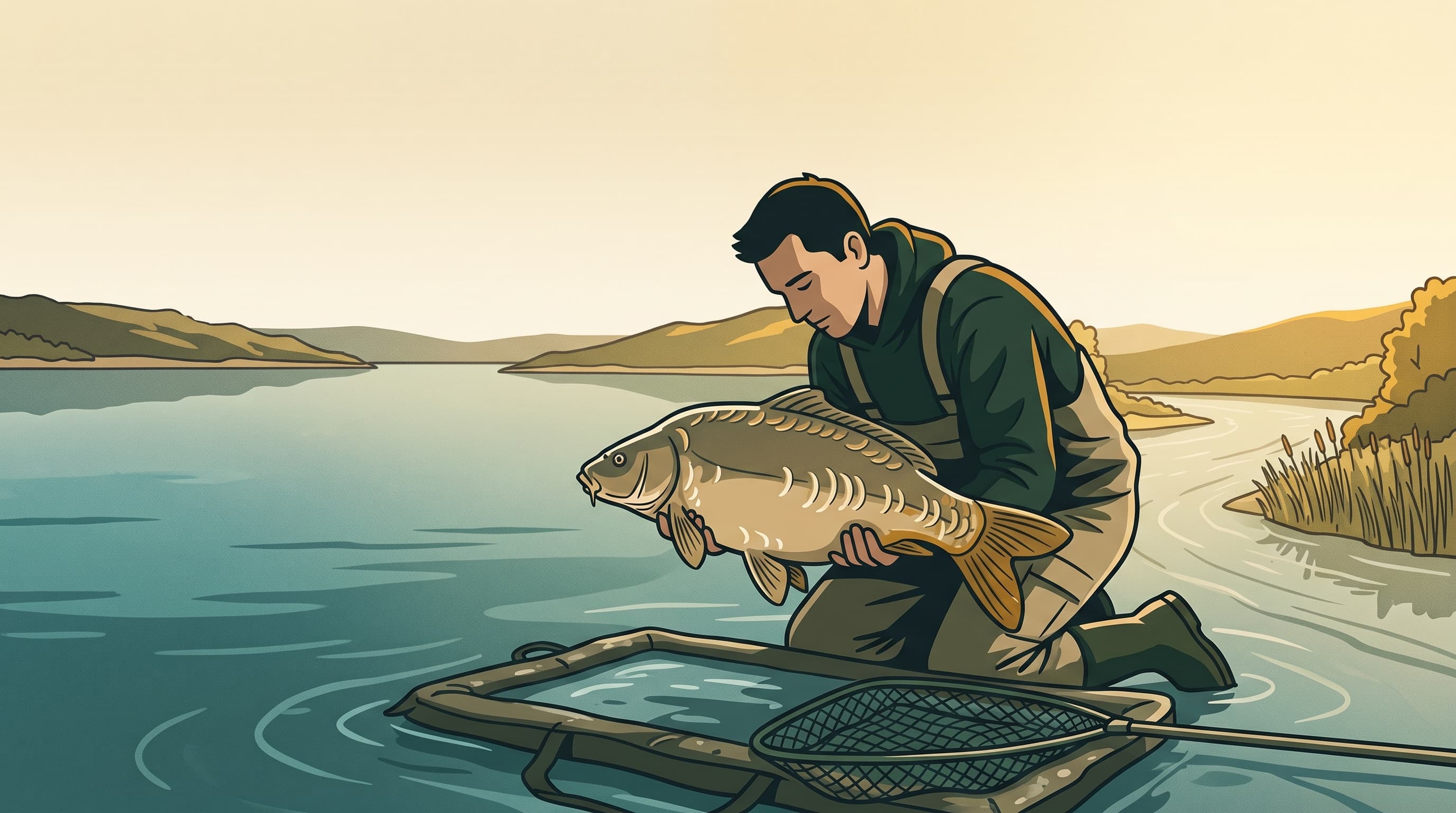
Seventh instalment of the CapseMaster series: what changes when targeting a big specimen or fishing pressured water, the 50 most common mistakes grouped by block, and a five-question decision tree for diagnosing why there are no bites.
Seventh part of the CapseMaster series: how things change when the goal is a big specimen or the water is heavily pressured, the 50 mistakes that ruin a session most often, and a decision tree for when there are no bites.
Fishing for big specimens and pressured fish
Targeting a big fish isn't doing the same thing with a bigger bait. It's accepting fewer bites in exchange for better ones, and that changes every decision.
The five decisions that change
- Swim: in general fishing, you fish where there's activity; targeting specimens, where you know big fish are, even with no sign today.
- Time on the spot: in general fishing, move if nothing in 6 h; targeting specimens may demand 24–48 h with no sign over the same spot.
- Bait: general — medium size, high attraction; specimens — big and hard, or very little bait, one that's highly visible.
- Baiting: general — enough to hold fish; specimens — enough not to fill them up, often almost nothing.
- Gear: general — standard; specimens — no weak point: leader, hook length, hook and knots checked one by one.
Pressured waters: what actually works

- Go where nobody goes. The single heaviest factor, ahead of any technical tweak. A swim 40 minutes' walk away can hold fish that haven't seen a rig in weeks.
- Unpopular hours. Midday, deep into the night, weekdays, bad weather.
- A different bait. Not "better" — different from what dominates the water.
- Less bait. In a water where 200 kg of boilie goes in a month, your edge isn't in adding kilo 201.
- A less common presentation. If everyone uses a chod, try a long combi with a wafter; if everyone uses a wafter, try a high pop-up.
The fight and landing a big fish
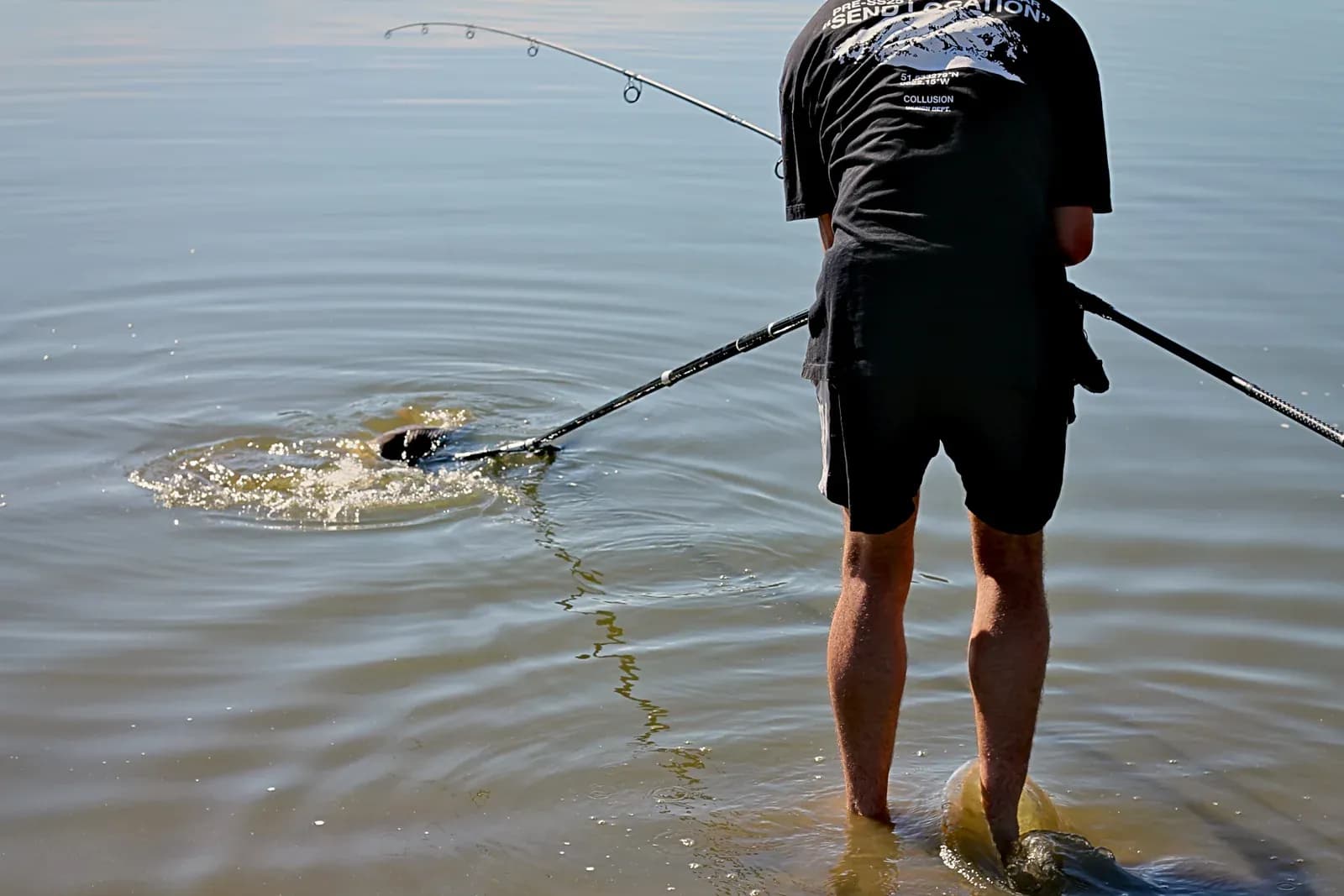
Netting the fish.
- The hook-set: with the self-hooking effect, don't strike. Lift the rod firmly and take up the slack line. A hard strike pulls hooks out.
- The first ten seconds: decide whether you need to steer the fish away from an obstacle. With trees or weed nearby, apply side pressure from the very first instant.
- The drag: set to give on the runs, never locked up. If you adjust it during the fight, do it in small increments.
- The angle: rod at 45°, letting the action do the work. Pumping with the rod near vertical concentrates all the force on the tip and the hook length.
- The final phase: this is when fish are lost. The fish is tired, close, with little line out: any sudden jerk breaks it. A sunk, still landing net — the fish comes to it, you don't chase it with the net.
- On lifting it out: never lift the net by the arms with the fish inside. Fold the arms in and carry the mesh, or transport the fish inside the mesh with the weight evenly distributed.
50 mistakes that ruin a session
Grouped in blocks, so you can audit your own fishing piece by piece.
Location (1-8)
- Setting up in the first free swim. Rushing or comfort. Consequence: a whole session on empty water. Fix: reserve 30 minutes to observe before unloading.
- Never plumbing. Laziness, or assuming it doesn't matter. Consequence: bait buried in silt. Fix: at least three casts with the lead.
- Always casting to the same distance. Habit. Consequence: never finding the bottom feature. Fix: fan the casts — one rod short, one medium, one long.
- Fishing deep by default in summer. The myth that "big fish live deep". Consequence: bait in an oxygen-poor layer. Fix: look for water movement, try mid-water with a zig.
- Casting on top of a jump. An impulsive reaction. Consequence: spooks the whole area. Fix: cast 10–20 m away, toward the nearest bottom feature.
- Ignoring liners. Treated as a nuisance. Consequence: losing the session's best piece of data. Fix: log them by time and rod; adjust distance.
- Never looking at the reservoir at low water. Only ever going to fish, not to look. Consequence: not knowing the basin. Fix: visit in summer with a camera and note coordinates.
- Moving your gear with every jump. Anxiety. Consequence: never any settled bait. Fix: fix a movement rule before starting.
Baiting (9-16)
- Baiting without checking if it's legal. Assumed to be normal. Consequence: a fine. Fix: check the closed-season order for that water.
- Baiting summer amounts in winter. Routine. Consequence: fed-up fish or a dead zone. Fix: use the scoring system from the baiting article.
- Topping up when fish are feeding. Impatience. Consequence: scatters the group. Fix: if there's bubbling, don't touch anything.
- Baiting by the clock. Automatism. Consequence: progressive saturation. Fix: bait by event — a catch or a sign.
- Using particles in cold water. Copying summer habits. Consequence: uneaten food on the bottom. Fix: small PVA and soluble bait.
- Always placing bait exactly on the rig. Because that's how it's taught. Consequence: wary fish detect it. Fix: in pressured waters, separate by 3–5 m.
- Responding to no bites with more bait. Anxiety. Consequence: makes it worse. Fix: move or change distance, don't bait more.
- Using PVA where baiting is banned. Assuming "it doesn't count". Consequence: it is baiting — a fine. Fix: no bait allowed means bare hookbait.
Rigs and presentation (17-26)
- Blunt hook. Not checked. Consequence: failed bites. Fix: fingernail test before every cast.
- Hair too long. Copied without adjusting. Consequence: fish take the bait without the hook. Fix: 2–5 mm from the bend.
- Not balancing the pop-up. Done at home, not checked. Consequence: the rig sits up or sinks wrong. Fix: balance in your own reservoir's water.
- A rig that doesn't release the lead. Badly assembled. Consequence: the fish drags the lead if the line breaks — it can die. Fix: check the release on dry land before casting.
- Using a chod on a hard, clean bottom. Fashion. Consequence: it performs worse than a hair rig. Fix: the chod is for dirty or unknown ground.
- A hook length too short over silt. Copying a hard-bottom setup. Consequence: buried bait. Fix: lengthen to 25–30 cm or use a helicopter.
- Changing the rig when there are no bites. Looking for a technical culprit. Consequence: wastes time, solves nothing. Fix: only change with evidence of fish present.
- Knots tied dry, not wetted. Rushing. Consequence: breaks under the fight. Fix: always wet and tighten slowly.
- Reusing a hook length after a big fish. Convenience. Consequence: breaks from micro-damage. Fix: a fresh hook length after every specimen.
- A zig with too big a bait. Copying bottom-fishing logic. Consequence: tangles and rejection. Fix: small foam, thin hook length.
Gear, hook-set and fight (27-38)
- Old line. Misplaced thrift. Consequence: breaks on the fish of the season. Fix: renew the first 100 m every season.
- A locked drag. Fear of obstacles. Consequence: breaks or pulled hooks. Fix: a drag that gives on a run.
- A drag too loose in weed. General habit. Consequence: a tangled fish. Fix: in weed, tighten up and lift the head.
- Striking the take. A reflex from other kinds of fishing. Consequence: pulls the hook out. Fix: lift with progressive firmness.
- Pumping with the rod vertical. Force applied wrongly. Consequence: breaks the hook length or the tip. Fix: 45° and steady pressure.
- Chasing the fish with the net. Nerves. Consequence: losing the fish a metre out. Fix: a sunk, still landing net.
- A short-armed landing net. Thrift. Consequence: risk of harm and of losing the fish. Fix: 100 cm minimum.
- Badly set alarms. Not calibrated. Consequence: false alarms or missed bites. Fix: adjust sensitivity to the day's wind.
- Crossed lines between rods. Careless casting. Consequence: a tangle on the first bite. Fix: separate angles, respect distances.
- A white torch pointed at the water. Convenience. Consequence: spooks fish in shallow water. Fix: red light, pointed at the ground.
- Noise on the bank. Not knowing better. Consequence: the lateral line detects it. Fix: step softly, don't drag chairs or buckets.
- Casting without checking the bobbin clip. Rushing. Consequence: the line breaks on the cast. Fix: check before every hard cast.
Handling, strategy and regulation (39-50)
- A dry mat. Rushing. Consequence: strips the fish's protective slime. Fix: always wet the mat, hands and fish.
- Fish on gravel or grass. No mat carried. Consequence: wounds and damaged scales. Fix: a padded mat with raised sides.
- A long handling session for photos. Social media. Consequence: stress and harm, especially in heat. Fix: have the camera ready before lifting the fish out.
- Holding the fish standing up, high. Imitation. Consequence: a fall and serious injury. Fix: kneel, over the mat, low.
- Pressing on gills or belly. Wrong grip. Consequence: internal damage. Fix: one hand under the pectoral fin, one under the anal fin.
- Releasing an exhausted fish without recovering it. Rushing. Consequence: delayed death. Fix: hold it in the water until it swims off on its own.
- Not carrying an unhooking tool. Thought unnecessary. Consequence: tears. Fix: forceps always in your pocket.
- Having no plan on arrival. Improvising. Consequence: random decisions. Fix: pick a strategy before setting up.
- Logging nothing. Trusting memory. Consequence: you don't learn from the water. Fix: a notebook — time, temperature, wind, sign.
- Assuming another region's rules. Habit. Consequence: a serious fine. Fix: check the order currently in force for that region.
- Releasing a carp where it's banned (or taking it home where release is mandatory). Not knowing its invasive-species status. Consequence: an offence either way. Fix: check the regime for that water (covered in detail in the next article, on regulations).
- Not disinfecting gear between waters. Not knowing better. Consequence: spreading zebra mussel; an offence. Fix: clean, dry and disinfect landing net, boots and everything that touches the water.
Diagnosing at the swim
Five questions, in order. Most carpers start with the fifth, which is why they don't fix anything. The order is the tool: each level rules out a cause before moving to the next. Changing the rig (level 5) without going through the previous four is guessing.
No bites:
- Have I seen any sign of fish? If no: a location problem. Move area, not rig — change bank, depth or a reservoir tail.
- Is the sign feeding-related? (clustered bubbling, disturbed water = yes; loose jumps = no). If no: fish present, not feeding. Try mid-water with a zig, or wait for the light to change.
- Do I have liners or line signs? If no: the bait isn't where they're feeding. Adjust distance ±10 m; fan the three rods out.
- Is the bottom what I thought it was? If no: a presentation problem. Switch to chod, helicopter or pop-up.
- Does the bait match their activity? Now, and only now, fine-tune: a smaller bait, a longer hook length, separated baiting, a different presentation.
Quick diagnoses by symptom
- Bites that don't materialise → likely cause: a blunt hook or a badly sized hair. First action: change the hook, shorten the hair.
- Bait comes back untouched after 10 h → likely cause: no fish in the area. First action: move, don't bait.
- Bait comes back clean and the baiting is gone → likely cause: small fish or crayfish. First action: increase bait size and hardness.
- Many liners, zero bites → likely cause: the bait is right next to the active zone. First action: adjust distance ±10 m before touching the rig.
- Repeated tangles on the cast → likely cause: a hook length too long or no anti-tangle tube. First action: shorten the hook length, use a solid PVA bag.
- The hook length comes back coiled around the leader → likely cause: a poorly executed cast or the wrong lead. First action: feather the spool before impact.
- Repeated breaks at the same point → likely cause: bottom abrasion or a bad knot. First action: a resistant leader, retie the knots.
- You only catch barbel → likely cause: bait too small or too soft. First action: an 18 mm+ boilie or tiger nuts.
This is the seventh part of a series based on the CapseMaster manual, 2026 edition. Fishing regulations change every season: this content does not replace the closed-season order currently in force in your region.
The whole CapseMaster series
- 1. What carpfishing is and carp biology, applied
- 2. Finding and reading carp
- 3. Gear and the rig catalogue
- 4. Baits and baiting
- 5. Nine complete strategies and fishing by season
- 6. Condition matrix, Spanish scenarios and session protocols
- 7. Big specimens, 50 mistakes and diagnosing at the swim
- 8. Fish care
- 9. Spanish carpfishing regulations
- 10. What to bring, 10-minute field guide, glossary and sources