
Nine complete strategies and fishing by season (5/10)
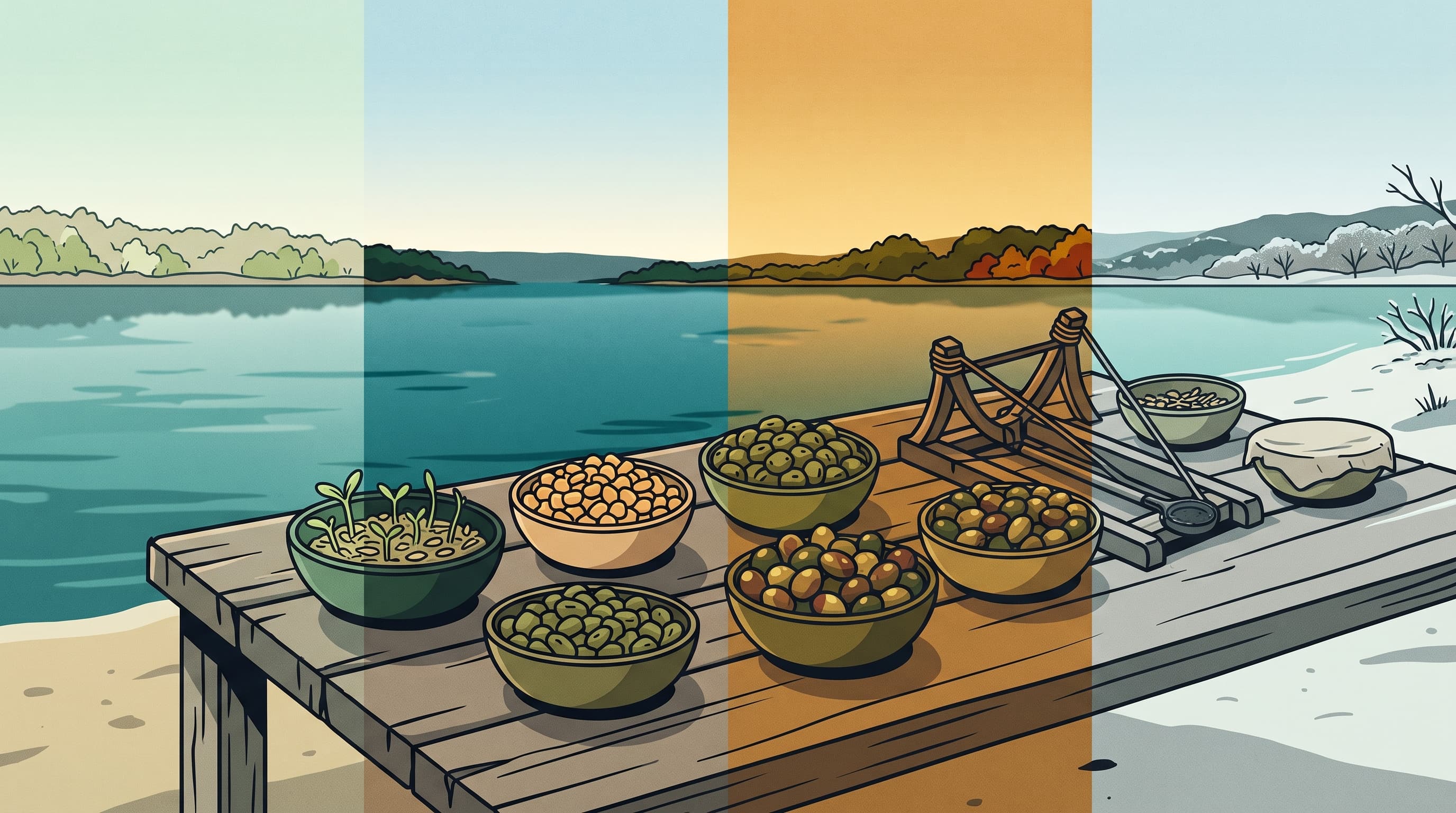
Nine complete strategies and fishing by season (5/10)
Fifth part of the CapseMaster series: nine complete strategies for specific situations, and how everything changes with the season in Spain.
Nine complete strategies
Each strategy is a coherent package: goal, baiting, bait, rig, and — most importantly — the signs that tell you it's working and the ones that tell you to change.
Strategy A · Few bites but big fish
- Goal: a single quality fish, accepting a session with no activity.
- Baiting: reduced and precise. Big, hard bait exclusively, so medium-sized fish can't take it.
- Bait: a 20 mm boilie or tiger nuts; a snowman rig.
- Frequency: once at the start. Top up only after a catch.
- Distribution: concentrated, 2 m radius, over a known bottom feature.
- Rig: combi rig 22–25 cm, size 4 hook, resistant hook length.
- Working well if… you get sporadic, wide-amplitude liners; on retrieval the bait is intact except for a few pieces.
- Change if… on retrieval all the bait is gone and you've had nothing: medium-sized fish are clearing it. Increase bait size or drop the amount to zero.
Strategy B · Prospecting for activity
Goal: find fish when you don't know where they are. Baiting: none or PVA. Rig: whatever's fastest to cast and reel in. Method: three rods in three different zones and depths; a two-hour rule — the rod giving no sign gets moved. Working well if liners show up on one of the three. Change zone of the reservoir if there's nothing on any of the three after four rotations.
Strategy C · Short session (4–6 h)
Goal: maximise probability in little time. Baiting: PVA and a handful; never build a carpet that'll take longer than the session to attract. Bait: high attraction and solubility. Timing: overlap with the 08:00–11:00 or 19:00–23:00 peaks. Working well if there's a sign in the first hour. If there's nothing halfway through, move 50 m — don't change the rig.
Strategy D · 24-hour session
Goal: cover a full light cycle. Baiting: medium on arrival, a small top-up before dusk and before dawn. Bait: boilie as the base, PVA on every cast. Rig: two rods over the baited spot, one exploring. Working well if there's activity at at least one of the two light changes. If dawn passes with nothing, it's the most reliable sign you're in the wrong spot.
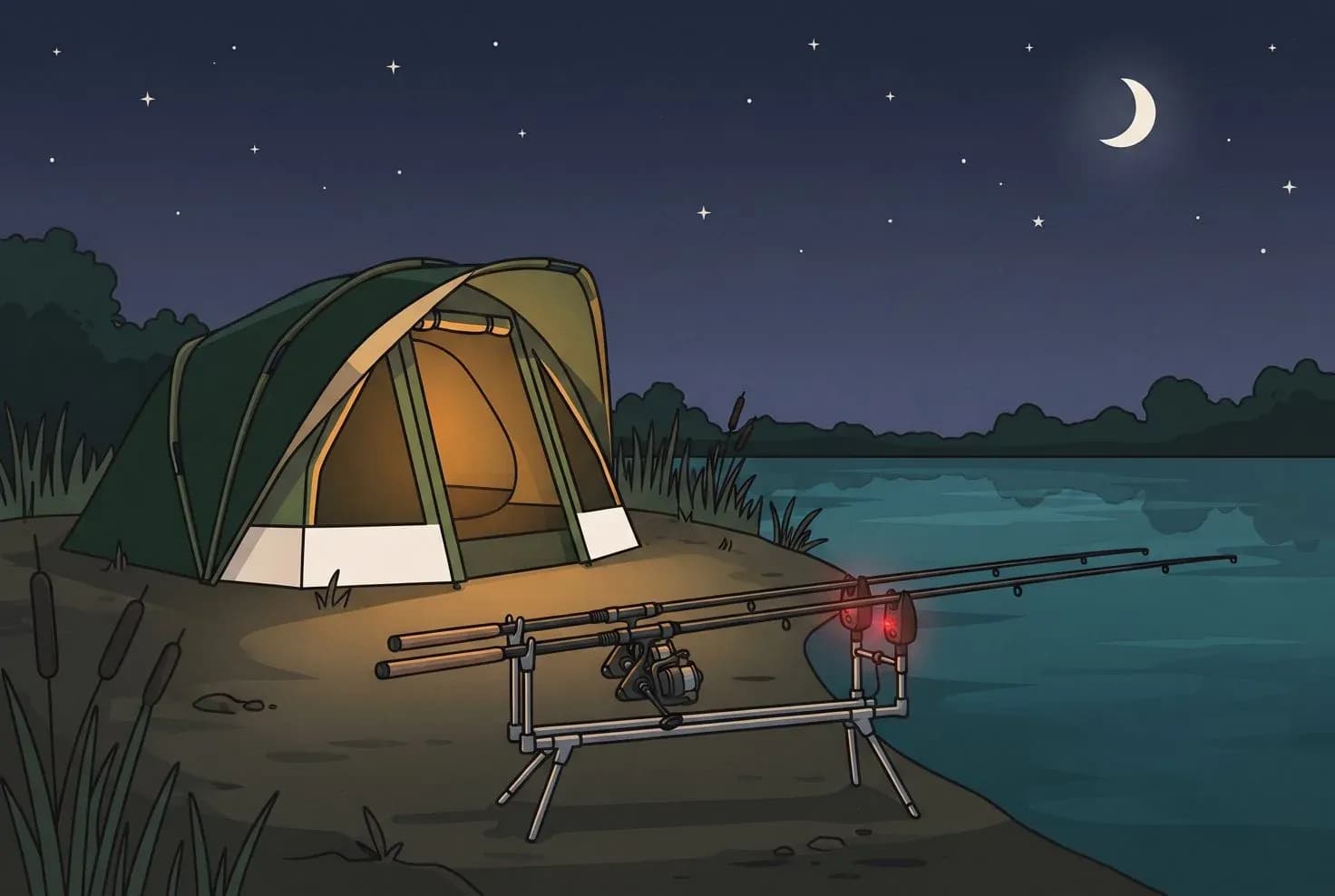
Strategy E · 48–72-hour session
Goal: establish a stable feeding zone. Baiting: high and sustained if temperature and population justify it; pre-bait the day before where legal. Management: top up little and often, rather than a lot at once. Rod rotation: always keep one rod "fixed" over the baited spot and one "mobile". Log: note time, temperature, wind and which rod produces; a pattern emerges over 72 h. Rest: sleep during the historically quietest periods, not when you feel tired.
Strategy F · Cold water (under 10 °C)
Goal: one bite. Baiting: minimal — a small PVA bag, nothing else. Bait: a bright, very soluble 12 mm pop-up. Rig: Ronnie or chod. Zones: old channel, stable deep areas, banks getting afternoon sun. Timing: below 10 °C, the evening-to-night window stretches out. Working well if you get the odd liner — in cold water it's almost the only sign. Change if there's nothing in 12 hours — move deeper or to a sunnier area.
Strategy G · Summer
Goal: take advantage of peak consumption (24–28 °C). Baiting: high, with particles and pellets if legal. Danger: oxygen-poor deep layers; don't fish "as deep as possible" by default. Key alternative: if the bottom gives nothing, try a zig rig — in Spanish summer fish spend a lot of time at mid-water. Fish care: in water above 24 °C, handling must be kept to an absolute minimum.
Strategy H · Heavy fishing pressure
Goal: offer something different. Baiting: spread, never a dense carpet on the obvious spot. Bait: an aromatic profile different from the water's dominant one (if everyone uses fishmeal, try fruit or spice). Rig: a longer hook length, a less common presentation. Zone: the awkward swims — a long walk in, banks with no car access — produce disproportionately. Working well if you catch at unusual hours (midday, deep into the night), when everyone else is asleep.
Strategy I · Very wary carp
Goal: turn liners into bites. Prior diagnosis: if you have liners and no bites, there are fish, and they're not going in. Adjustments, in this order: (1) reduce the bait size; (2) lengthen the hook length; (3) move the baiting 3–5 m away from the rig; (4) change presentation (sunk to wafter, or the reverse); (5) only then, change the rig. Change your read if, after all five adjustments, you still get liners with no bites — it may not be carp, but barbel or catfish passing by.
Strategy by season
In Spain the most decisive seasonal variable isn't cold: it's the reservoir's water level and temperature, which don't follow the calendar.
A pink dusk over the reservoir.
Spring (March–May)
Temperature 10 to 20 °C, rising fast and unevenly: shallow tails warm up first. Behaviour: rising activity, fish seek the warmest zones and feed to recover from winter; then spawning changes everything. Zones: tails, shallow bays, north-facing banks getting sun all day, emerging vegetation. Depth: shallow — in March, 1.5–3 m can beat 8 m. Timing: the middle of the day gains importance over dawn, especially in March. Baits: high attraction, birdfood, corn, increasing quantity as temperature rises. Rigs: watch for growing weed — chod and pop-ups matter more from April on.
Common mistakes: baiting in March like it's June; fishing deep out of habit; ignoring the closed season — several regions have specific spawning-time restrictions for cyprinids, Madrid bans fishing any cyprinid within 50 m of weirs and dams during April and May.
Summer (June–September)
Temperature 20 to over 28 °C: the period of maximum consumption — and maximum risk for a caught fish. Behaviour: intense feeding but strongly tied to light, activity at dawn, dusk and at night, prolonged basking at midday. Zones: wind-battered banks, water inflows, weed edges; watch for oxygen-poor deep layers. Depth: variable — if the bottom isn't producing, go up, mid-water is often where they are. Baits: fishmeal, pellets, particles; the only season where volume makes sense. Rigs: the zig rig as a primary diagnostic tool, not a last resort.
Common mistakes: handling fish in 26 °C water as if it were April; baiting at midday; hunting for depth by default.
Autumn (October–November)
Temperature dropping from 20 toward 12 °C, waters mixing and evening out. Behaviour: for many Spanish carpers, the best season — fish feed intensely before the cold, and the thermocline is gone. Zones: the whole reservoir becomes accessible; the first rains and a rising level spike activity in newly flooded areas. Baits: energy-dense, nutritionally rich baits — fish are building reserves.
Common mistake: cutting back baiting too early. In October carp are still eating heavily.
Winter (December–February)
Temperature 12 down to below 6 °C depending on region; in southern Spain it rarely drops below 8–10 °C — the Spanish "winter" is often a long autumn. Behaviour: sharply reduced intake, but not zero; fish group up and move little. Zones: old channel, stable deep basins, areas sheltered from cold wind, banks getting afternoon sun. Timing: below 10 °C the afternoon window stretches into the small hours; the 08:00–11:00 morning peak still holds. Baits: very little, very soluble, very visible — a bright 12 mm pop-up over a small PVA bag.
Common mistakes: baiting summer quantities; moving constantly (in winter, finding the shoal takes time and it's worth waiting); writing off the session by 10:00.
Expert tip: in Spain, go by water temperature, not the month. An Extremaduran reservoir at 14 °C in January fishes like a Pyrenean one in April. Carry a thermometer — it costs little and reorders every decision in this chapter.
This is the fifth part of a series based on the CapseMaster manual, 2026 edition. Fishing regulations change every season: this content does not replace the closed-season order currently in force in your region.
The whole CapseMaster series
- 1. What carpfishing is and carp biology, applied
- 2. Finding and reading carp
- 3. Gear and the rig catalogue
- 4. Baits and baiting
- 5. Nine complete strategies and fishing by season
- 6. Condition matrix, Spanish scenarios and session protocols
- 7. Big specimens, 50 mistakes and diagnosing at the swim
- 8. Fish care
- 9. Spanish carpfishing regulations
- 10. What to bring, 10-minute field guide, glossary and sources