
What to bring, 10-minute field guide, glossary and sources (10/10)
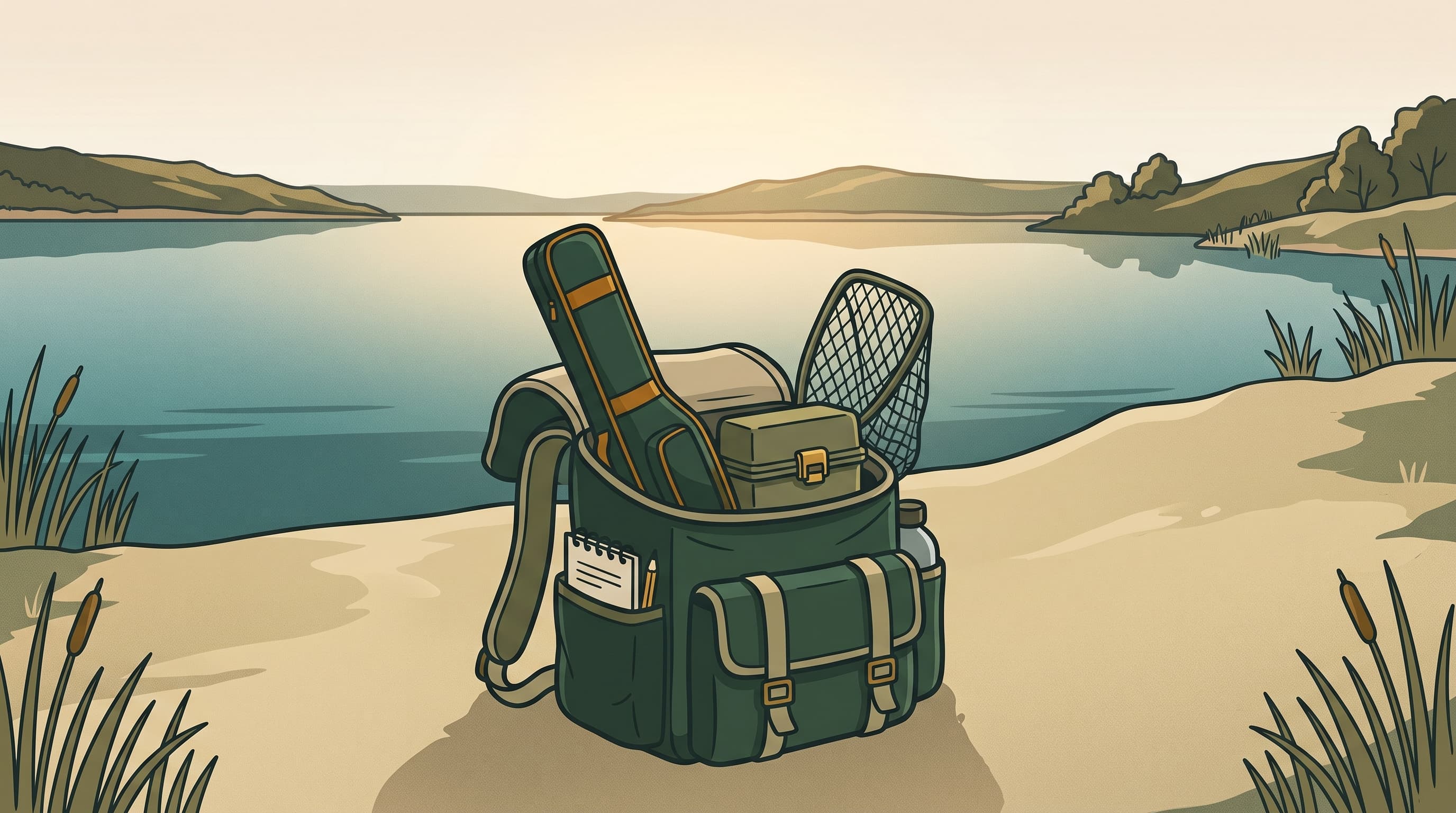
Final instalment of the CapseMaster series: what gear you'd take if you had to cut it to the bone, a ten-step field guide to read on your phone at the swim, four checklists, a glossary of terms, and the sources behind the whole manual.
Tenth and last part of the CapseMaster series: what you'd take if you had to cut your gear to the bone, a ten-minute field guide, four checklists, a glossary and the sources behind the whole manual.
"If I could only bring…"
Cutting down your options forces you to justify each one. These are the choices the manual would defend, and why.
If I could only bring 3 baits:
- A 15–16 mm boilie, fishmeal profile (or corn, where boilies aren't legal). It's the workhorse: it lasts, it selects, and it works across the widest thermal range of the Spanish year.
- A bright 12–14 mm pop-up. Covers cold water, dirty bottoms and fish that need to see the bait. The one that saves the hard sessions.
- A wafter with the same profile as the boilie. A neutral presentation, the most natural over clean ground, and lets you fish in line with your baiting.
Why not particles: excellent in summer, but very seasonal and high risk of overfeeding. With only three slots, versatility wins.
If I could only bring 3 rigs:
- A hair rig with blowback on an inline lead, for hard, clean bottoms.
- A 22 cm combi rig, for mixed, slightly soft bottoms and wary fish.
- A chod rig, for unknown bottoms, deep silt or weed.
Together the three cover almost any Spanish bottom. The Ronnie beats the chod on hard ground, but the chod solves a problem nothing else does: presenting well without knowing where the lead lands.
If I could only bring 2 types of hook length: 20–25 lb coated braid (skins where needed, allows hair rig, blowback and combi — one spool covers 80% of rigs) and 20–25 lb stiff mono (chod, D-rig and anything needing stiffness and separation).
If I could only bring 3 types of lead: an inline, pear-shaped, 100 g — the reservoir standard, maximum transmission; a lead clip with a 90 g lead — safety in weed and obstacles; and a 140–170 g flat or grip lead — river current and strong wind. In Catalonia, all three in tungsten, steel or bismuth: lead is banned.
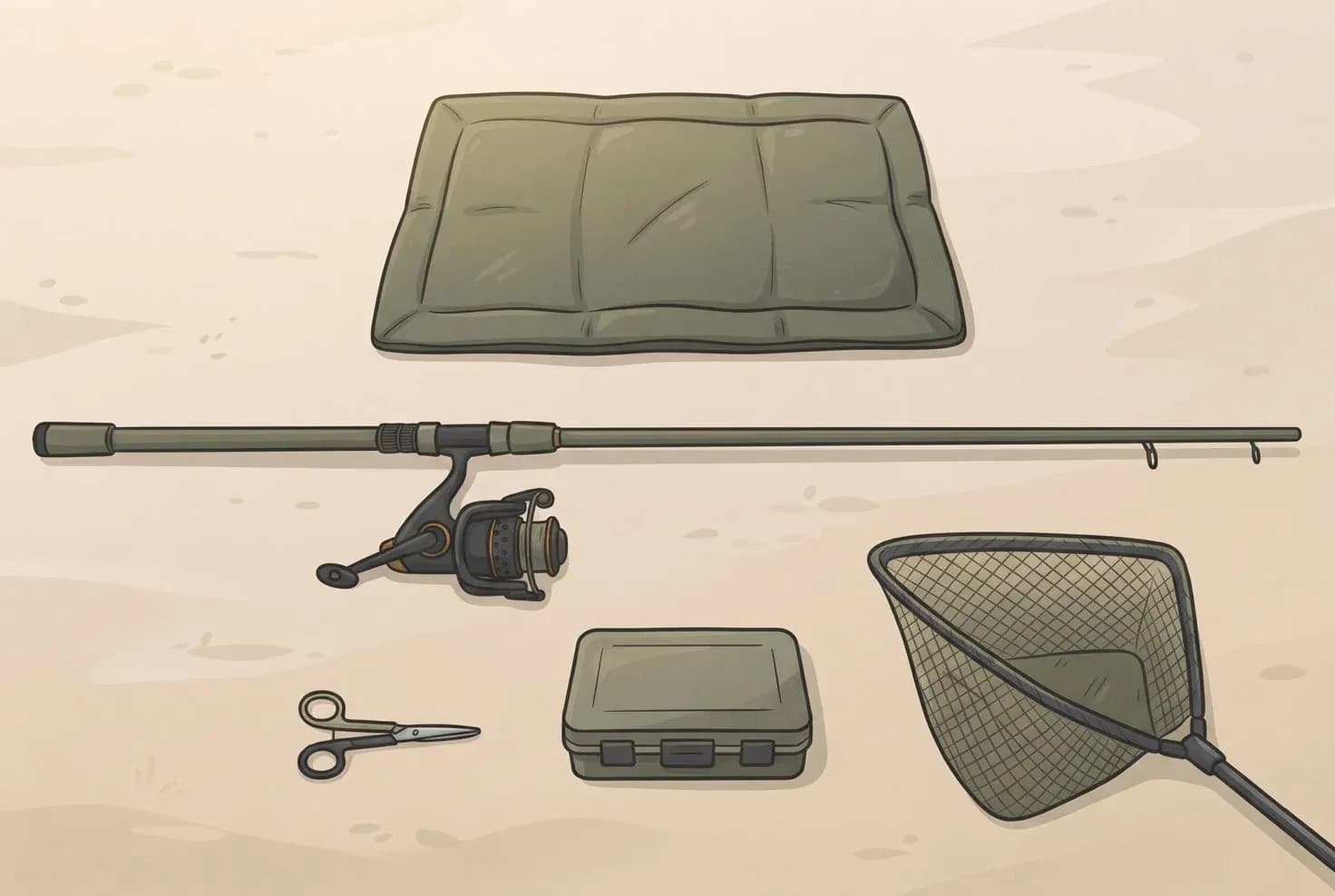
On a low budget, spend in this order: a 100 cm landing net, a padded mat, forceps and a bucket (landing gear, non-negotiable), then a reel with a reliable drag, then new line, then quality hooks, and last the rod. The rod is where a cheap buy costs least. You can skip alarms if you have to: a home-made bobbin indicator and staying alert work.
On a medium budget, add: two more rods to cover three depths, alarms with a receiver, a plumbing lead with dedicated braid, and a thermometer. The thermometer costs less than five boilies and reorders every baiting decision.
Targeting big specimens, invest in time and knowledge of the water, not gear: low-water visits to the reservoir, systematic plumbing, a log book. Then in gear that won't fail: leader, high-quality hooks, fresh line. A 20 kg fish is lost at the weakest link, and that link is never the rod.
As a beginner: one rod, one reel, 0.30 mm line, 100 g inline leads, size 6 hooks, coated braid, 15 mm boilies and full landing gear. One rig: a hair rig with the knotless knot. Spend your first ten sessions learning to plumb and read the water, not testing rigs. It's what gets you catching fastest.
Carpfishing in 10 minutes: field guide
Designed to be read on your phone, at the swim, with one hand. Ten steps in order.
Step 0, before you get out of the car: do you have a licence and permit? Do you know what to do with a carp caught here? Can you bait? Until what time can you fish? If in doubt about any of these, sort it out before rigging up.
- Look at the water. Thirty minutes without touching the car. A high point, sun behind you, polarised glasses. You're gathering information, not looking for somewhere comfortable.
- Look for activity. In order of value: clustered, moving bubbling > disturbed water over a clean bottom > carp patrolling in a line > rollers > repeated jumps in one area > an isolated jump (ignore it).
- Identify the bottom. Three casts with the lead. Fine vibration = hard. It sticks = silt. Elastic resistance = weed. Nothing = deep silt. Smell the lead: rotten-egg smell = dead zone, move.
- Choose your spot. The best spot combines a fish sign + a bottom feature. If you only have one of the two, go for the bottom feature (plateau, step, old channel, hard/soft transition).
- Pick the rig by bottom: hard and clean → hair rig + blowback, inline lead. Light silt → 22–25 cm combi rig, wafter. Deep or unknown silt → chod rig. Weed → helicopter + lead clip, pop-up. Fish high in the water → zig rig. Current → hair rig, 110–170 g lead.
- Pick the bait: water under 10 °C → soluble 12 mm pop-up. 10–18 °C → 15 mm boilie or wafter. Over 18 °C → 16–18 mm fishmeal boilie. With bleak or crayfish → go up to 18–20 mm or use tiger nuts. Always check the bait is legal there.
- Decide how much to bait. Score fast, 0 to 2: temperature, activity, fish density, duration, pressure, natural food, bait type. 0–3: PVA only. 4–6: half a kilo. 7–9: 1–2 kg. 10+: sustained baiting. If unsure, bait less.
- Set the rig. Check: hook point with your nail, hair 2–5 mm from the bend, the lead releases if the line breaks, bobbin clip in place, drag set and not locked. Bait before casting, not after.
- Watch. Don't touch the rods. Log the time and rod for every liner. Liners are your radar: many liners with no bites means you're right next to the active zone — adjust distance by 10 m.
- Adapt. No sign at all in 6 h → a location problem: move, don't add bait or change the rig. Liners with no bites → adjust distance first, then a smaller bait, then a longer hook length. Visible activity and nothing → try mid-water (zig) or wait for the light to change. Failed bites → a fresh hook and a shorter hair. Bait intact after 10 h → no fish, move. Bait clean and the baiting gone → small fish, go up in size and hardness.
If you remember only one sentence from the whole manual: a lack of bites is almost never a rig problem. It's a problem of where the bait is.
Checklists
Four lists. Printed or on your phone, each takes under a minute to run through.
Before leaving: licence valid and current in that region · permit for the reserve or stretch, if needed · current closed-season order downloaded on your phone · checked whether carp is fishable there and what to do with it · checked whether baiting is allowed and with what materials · checked legal hours and any free-schedule stretches · checked the maximum number of rods · weather and wind forecast · reservoir level and condition · bait prepared (boiled particles and tiger nuts) · rigs tied at home (at least 6) · spare fresh hooks · full landing gear · gear disinfected since the last trip · torch and phone battery charged.
On arrival: observe for 30 minutes before unloading · look for bubbling, disturbed water, patrolling fish · check wind direction and temperature · plumb for depth and distance · identify the bottom type (and smell it) · locate features (plateau, step, transition) · choose three different spots · mark distances with the bobbin clip · plan baiting using the scoring system from the baiting article · unroll and wet the mat · assemble the landing net and keep it accessible.
Before every cast: hook point, fingernail test · hair 2–5 mm from the bend · bait secure and the stop firm · hook length free of nicks or curls · knots wetted and tightened · the lead releases if the line breaks · PVA bag or stick dry and air-free · bobbin clip at the correct distance · drag or baitrunner set · lines not crossed with other rods · confirm the zone allows fishing.
After a bite: lift firmly, don't strike · steer the fish away from obstacles in the first seconds · rod at 45°, steady pressure · get the landing net ready, sunk and still · wet the mat before lifting the fish out · wet hands · unhook with forceps, no pulling · antiseptic if there's a wound · weigh only if it's worth the time · a photo kneeling, fish low, max 45 s · recover it in the water until it swims off on its own · act per the regulations applying to carp there · a fresh hook length before recasting · top up bait in a small amount · log time, rod, prior sign and conditions.
Glossary
- Hook length (bajo de línea): the final section of the rig, between the lead and the hook. Its material and length define how the rig behaves.
- Baitrunner: a reel's free-spool system letting a fish take line with no resistance until the drag is engaged.
- Blowback: a hair rig variant with a sliding ring on the shank that lets the bait slip backward, freeing the hook to turn.
- Boilie: a ball of paste made from flours, egg and attractors, boiled to harden it. Carpfishing's signature bait.
- Bolt rig / self-hooking effect: a system where the lead's weight produces the hook-set as the fish tries to expel the bait.
- Chod rig: a rig with a short, stiff hook length running on the leader between two stops, letting you present over dirty or unknown bottoms.
- Tiger nuts (chufa): a tuber used as bait. Must be soaked and boiled before use.
- Lead clip: a fitting that holds the lead and releases it under tension.
- Combi rig: a mixed hook length — a stiff section by the hook, a soft one toward the lead.
- Curve shank: a curved-shank hook that favours turning and gripping the lip.
- D-rig: a rig where the bait is mounted on a stiff "D" that runs along the shank.
- Feathering: braking the line with a finger at the end of the cast so the rig lands laid out.
- Hair rig: a rig where the bait hangs from a hair behind the hook, leaving the hook free.
- Helicopter (rig): a system where the hook length spins freely on the leader, above the lead.
- Knotless knot: creates the hair and fixes the hook in a single operation.
- Leader (líder): the stronger line section between the main line and the rig, absorbing abrasion and casting stress.
- Liner: a bobbin movement caused by a fish brushing the line without taking the bait.
- Marker float: a float used to fix distance and depth. Restricted or banned in some regions.
- Unhooking mat: the padded mat a fish is handled on.
- Pop-up: a floating boilie, balanced with a counterweight.
- PVA: polyvinyl alcohol, a water-soluble material used in bags, mesh and string to deposit bait right on the rig.
- Ronnie / Spinner rig: a low pop-up rig with the hook mounted on a rotating swivel.
- Snowman: a combination of a sunk boilie and a smaller pop-up on the same hair.
- Spod / Spomb: baiting "rockets" cast with a dedicated rod that release bait on hitting the water.
- Wafter: bait of near-neutral buoyancy.
- Wide gape: a wide-gape hook, common in a hair rig with a sunk bait.
- Zig rig: a very long hook length presenting a light bait at mid-water.
- EEI (Especie Exótica Invasora): invasive alien species — the legal category carp falls under in Spain.
- Orden de vedas (closed-season order): the annual regional rule setting fishable species, seasons, bag limits, baits, hours and each water's regime.
Sources and references
The whole original manual was built from sources checked on 26 August 2026, with an accuracy check on data, figures and legal citations. Grouped by type:
Official, national regulations: Law 7/2018 amending Law 42/2007 on Natural Heritage and Biodiversity (BOE no. 176, 21/07/2018), which introduces article 64 ter; Royal Decree 630/2013, Spanish Catalogue of Invasive Alien Species, which sets carp's legal status; and Supreme Court ruling STS 637/2016, which added carp to the catalogue.
Official, regional regulations: the portals and closed-season orders of the Community of Madrid (Order 815/2026), Castilla-La Mancha (Order 20/2026), Aragón (Order MAT/1888/2025 and the General Fishing Plan), Extremadura ("Pesca y Ríos" portal, free-schedule stretches), Catalonia (Resolució ARP/902/2026 and Llei 22/2009), La Rioja, Castilla y León (Order FYM/339/2019), Andalucía, and the usage rules of the Mar de Aragón sports fishery.
Scientific: peer-reviewed work on carp feeding behaviour, including Sibbing (1986) on food-handling patterns in Cyprinus carpio, Kasumyan (1996) on taste sensitivity to free amino acids, studies on the effect of temperature on feeding rate across the 4–34 °C range, work on foraging and growth in juvenile carp, and the Cyprinus carpio fact sheet from the European LIFE+ MedWetRivers project.
Technical and specialist: publications and guides on Spanish carpfishing venues, always cross-checked against official regulations where there was a discrepancy; national fishing-licence and regulation portals; and conservation publications on the debate around invasive-species management.
Final warning from the original manual: it was compiled with accuracy checks on data, figures and regulatory citations. Even so, Spanish continental fishing regulations change every season and vary by body of water. No statement in this manual, or in this article series, replaces the closed-season order in force, a reserve's technical plan, or the signage on the stretch. When in doubt, the valid source is the relevant region's official gazette.
This is the tenth and final part of the series based on the CapseMaster manual, 2026 edition. Thanks for reading this far: if you found it useful, the rest of the blog has my own catches, trips, baits and rigs, told from the bank.
The whole CapseMaster series
- 1. What carpfishing is and carp biology, applied
- 2. Finding and reading carp
- 3. Gear and the rig catalogue
- 4. Baits and baiting
- 5. Nine complete strategies and fishing by season
- 6. Condition matrix, Spanish scenarios and session protocols
- 7. Big specimens, 50 mistakes and diagnosing at the swim
- 8. Fish care
- 9. Spanish carpfishing regulations
- 10. What to bring, 10-minute field guide, glossary and sources