
Finding and reading carp (2/10)
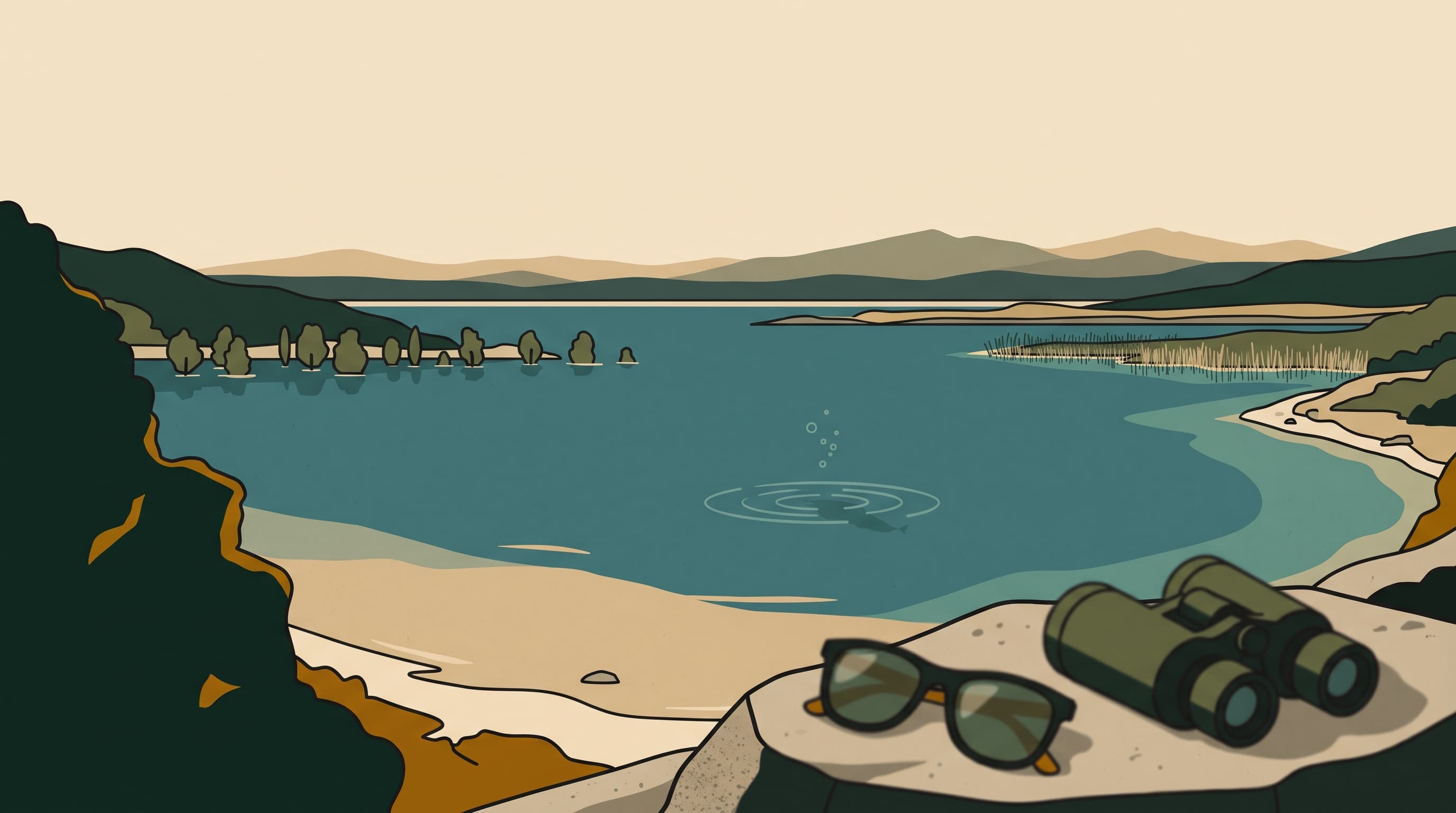
Second instalment of the CapseMaster series: how to read a Spanish reservoir or river to find where the carp are, and how to interpret jumps, bubbling and liners without falling for the most common mistakes.
Second part of the CapseMaster series: where to look for carp in Spanish reservoirs and rivers, and how to read the signs the water gives you.
Finding the carp: the swim matters more than the bait
A mediocre rig in the right spot catches fish. The best rig in the world in the wrong spot catches nothing. On Spanish reservoirs covering thousands of hectares, this hierarchy isn't up for debate.
The order of priorities
On arriving at a water, solve the problems in this order. Each level only makes sense once the previous one is settled:
- Are there carp in this part of the water? If this fails, nothing else matters — change area.
- At what distance and depth are they? If this fails, you'll bait and cast into a desert 30 m from the fish.
- What exactly is the bottom like at that spot? If this fails, the bait may end up buried in silt or weed.
- What presentation does that bottom call for? Here, and only here, is the rig decided.
- What bait, and how much? It's the last decision, not the first.
The classic mistake of the improving carper is inverting this pyramid: four hours spent perfecting a chod rig, five minutes spent choosing where to put it.
Reading a reservoir
The typical Spanish reservoir — regulated, with major level swings — gives the observant angler a huge advantage: when the level drops, the bottom is exposed. A reservoir at low water in September is a free map for the following spring's sessions. It's worth photographing.
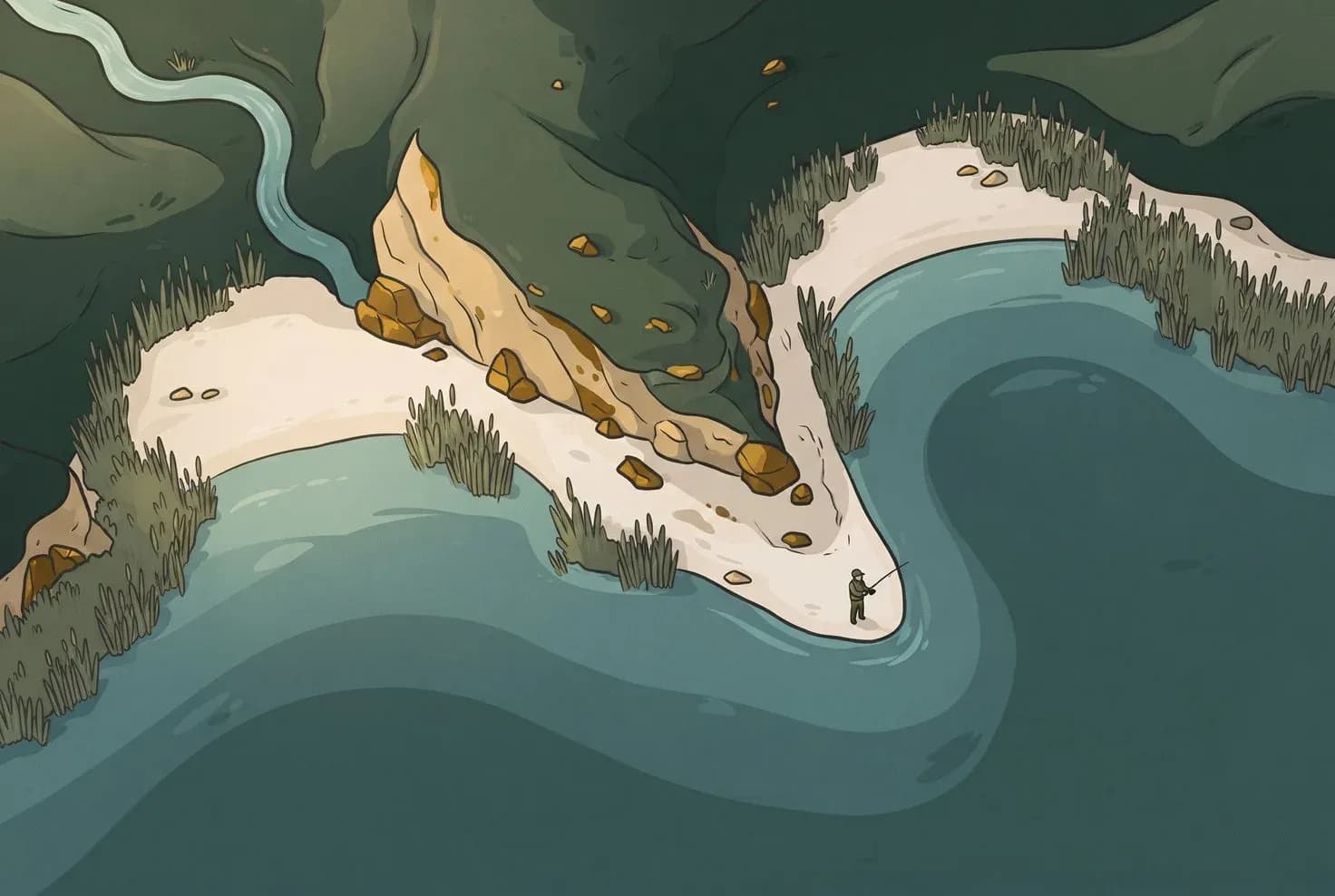
Six bottom features concentrate carp, almost none visible from the bank: they have to be plumbed.
- Plateau: a flat, raised area, more light and often cleaner, harder ground. Accessible bottom food and clear travel routes. Fish with concentrated baiting over the high part and a hard-bottom rig; mark the edge with a marker float.
- Depth change (step): sharp changes act like highways, fish move along them. The bait goes right on the break, not above or below it: precision casting.
- Old channel: the original riverbed before the reservoir was built. Harder bottom, travel route and thermal refuge in the cold. In winter it's one of the few features that keeps producing; baiting should be very light, right in the channel.
- Sunken tree or structure: shelter, safety and attached food. Fish near it, not inside it, with tight drags and a resistant leader; the risk of losing a fish snagged is high and worth weighing up.
- Submerged weed: invertebrates, oxygen and cover. A prime feeding zone in spring. The presentation goes over the canopy (pop-up, chod) or in localised clear patches.
- Bottom transition (hard to soft): the change concentrates food and is a natural reference point for fish. It's the most underrated of all: locate it by plumbing, and put the bait on the hard side.
Other high-value features on Spanish reservoirs:
- Reservoir tails: shallower, warm up earlier in spring, receive nutrient input and oxygenated water. In March–April they're often the best spot on the reservoir.
- Stream and creek mouths: food washed in and oxygen after rain. Watch the rules: some regions ban fishing within 50 m of weirs and fish ladders, and in the Community of Madrid cyprinid fishing is banned within 50 m of any weir or dam during April and May.
- Sheltered coves and bays: shelter in strong wind, calm sunny spots.
- Rocky banks with a steep drop-off: let fish move from the safety of deep water to feed within a few metres; very productive on pressured waters.
- Flooded areas after a level rise: when a reservoir rises after rain, the flooded land vegetation releases food immediately. One of the most productive, and briefest, situations of the year.
Reading a river
Spanish rivers holding carp — the Ebro, Tagus, Guadiana, Segura, Júcar in their middle and lower reaches — change the priorities: current replaces wind as the driving force, and fish don't "patrol", they position themselves.
- Pool below rapids: food carried by the current settles here; high oxygen. Needs enough lead to hold (often 110–170 g on the Ebro) and a heavy bait that won't roll.
- Slack water and back-eddy: fish rest and feed without spending energy. Spotted by swirling foam. Lighter lead; tighter baiting since it doesn't disperse.
- Inside of a meander: fine sediment and food settle here; less current. Watch for silt: soft-bottom rig.
- Undercut bank: shelter with permanent shade and roots. Fish close, in total silence, with a resistant leader.
- Obstacles (bridge piers, fallen trees): break the current and create dead zones just downstream. Put the bait in the dead zone, not the turbulence.
- Confluences: two bodies of water with different temperatures and loads, food concentrated. Work the mixing line, visible by colour.
Legal note (rivers): in several regions, river stretches have a different regime from reservoirs. In Castilla-La Mancha, for example, baiting is banned in general, with exceptions only for non-trout reservoirs and their diversion channels. In other words: in many stretches of Manchegan rivers, baiting is an offence even if the adjoining reservoir allows it. Check it stretch by stretch.
Lagoons, ponds and private waters
Small waters flip the logic: locating fish is easy, fooling them is hard. Fishing pressure concentrates and the fish know the baits. On lagoons it pays to downsize the bait or switch to something different from what the water usually sees, keep the baiting away from the rig, and fish the margins before casting to the middle. Many lagoon fish spend the day three metres from the bank you're casting 60 m from.
Spain also has privately managed fisheries recognised by regional administrations, some explicitly geared to carpfishing. Being managed, they often allow what free waters don't: overnight stays, long sessions, catch and release. Their own rules override the general ones.
Location tools
Observation (the first and the best). Spend the first 30–45 minutes looking, not rigging up. Climb to a high point if there is one, sun behind you, polarised glasses on. Look for: jumps, bubbling, murky water over a clean bottom, reeds or vegetation moving with no wind, and birds — coots and grebes gathered often mark feeding zones.
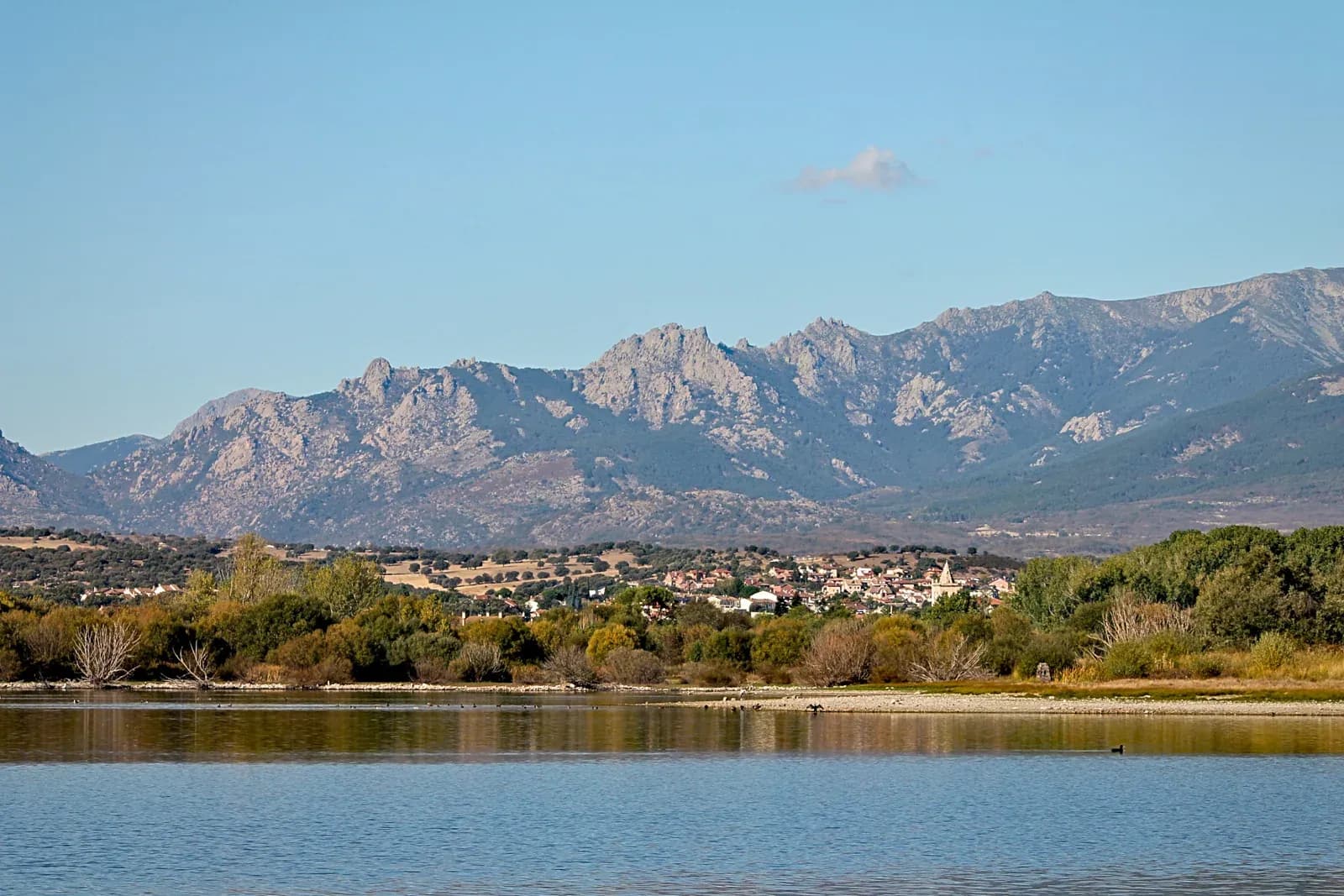
View of the reservoir with the mountains behind.
Plumbing lead. A 90–110 g streamlined lead on braid (no stretch, to transmit feel) reads the bottom two ways: the feel while dragging it, and the drop time.
What you feel when dragging the lead says a lot about the bottom:
- Fine vibration, "scratchy" → compacted gravel or sand. Hard bottom, ideal for a bottom rig and a sunk bait.
- Dull, irregular knocks → stone, rock. Watch for leader abrasion; use tube or a leader material.
- Weight that "sticks" and is hard to pull free → silt or mud. The bait will sink in: lighter lead, longer leader, or a pop-up.
- Elastic resistance that gives suddenly → weed. A chod, a high pop-up, or find a clear patch.
- Nothing, it slides smoothly with no vibration → very deep silt or leaf litter. A zone to avoid except with a specific presentation.
For drop time: cast, and count the seconds from when the lead hits the water to when the line goes slack. Repeating the count in a fan gives you an approximate depth profile without a sounder.
Marker float. Lets you fix distance and depth visually and bait over it exactly. Legal note: in Aragón, the rule governing baiting in fishing scenarios says marker floats can't be used to signal baiting spots, and baiting can only be done from the bank. Always check whether your region allows the marker.
Echo sounders and boats. Where allowed, a sounder — including cable- or wifi-cast ones — drastically speeds up reading the water. But boats and floats are restricted in many Spanish stretches to protect birdlife or control invasive species, with seasonal closures. Also, disinfecting equipment that touches the water is mandatory in several regions to prevent the spread of zebra mussel, Asian clam and rock snot: landing nets, boats, waders and boots included.
Expert tip: if you can't or don't want to plumb, there's a shortcut that works surprisingly well: count the casts left by other anglers' previous sessions. On busy reservoirs, swims with trampled vegetation, tangle-scraps and flattened grass mark where people fish — which, very often, are the zones where fish get caught. Not elegant, but free information.
Reading the fish: signs and what to do about them
Seeing activity and locating where fish feed aren't the same thing. Confusing them is the most expensive interpretation mistake in carpfishing.
Reading table: I see this → it probably means → I do this
Confidence indicates how reliable the interpretation is, not how often the sign appears.
- Fine, clustered bubbling that drifts slowly — fish disturbing the bottom while feeding, the most reliable sign of all. High confidence. This is your spot: cast to the edge of the bubbling, not on top of it. Minimal or no baiting, they're already feeding.
- Murky water or "smoke" over a clean bottom — sediment stirred up by feeding fish, often alongside bubbling. High confidence. Same as above; if the cloud is moving, follow its direction and get ahead of it.
- Large, isolated bubbles, always in the same spot — decomposition gas from the bottom, no fish. High confidence. Ignore it; it also indicates deep, anoxic silt, a bad spot for the bait.
- Full jump, repeated, in the same area — fish present in that area, not necessarily feeding there. Medium confidence. A valid zone to explore; combine with plumbing before committing your baiting.
- A single, isolated jump far from anything — a fish in transit or social behaviour, not very informative. Low confidence. Note it mentally, don't move your gear for one jump.
- A "roller": back breaking the surface with no jump — a fish near the surface or coming up from mid-water, often associated with active fish. Medium confidence. Consider a zig rig or high presentation; very telling in summer.
- Carp basking still at the surface — sunbathing, fish unlikely to feed on the bottom. Medium confidence. Don't bait the bottom; try the surface where legal, or wait for the light to change and prepare the bottom for then.
- Carp crossing in a line, on a steady heading — patrolling, a travel route. High confidence. Put the bait on the route, not where you saw them; very light baiting, in a line.
- Reeds or rushes shaking with no wind — fish moving through margin vegetation. High confidence. Margin fishing, no long casting, total silence.
- Loose floating vegetation rising — fish feeding among the submerged plants. Medium confidence. Find the nearest clear patch and present over the canopy.
- Bleak or small fish fleeing at the surface — a predator (pike, black bass, zander), not carp. Medium confidence. Irrelevant to carp fishing; don't move for this.
- Line tightening and slackening with no bite (liners) — fish brushing the line as they move: they're close, but probably not over the bait. Medium confidence. A very valuable sign: it often means the bait is just outside the active zone; shorten or lengthen the cast by 5–10 m.
Jumps: what they really mean
It's the most repeated question in carpfishing, and the worst-answered. There isn't enough evidence for a general rule translating a type of jump into a specific feeding state. What can be done is classify what you observe and avoid the most frequent wrong conclusions.
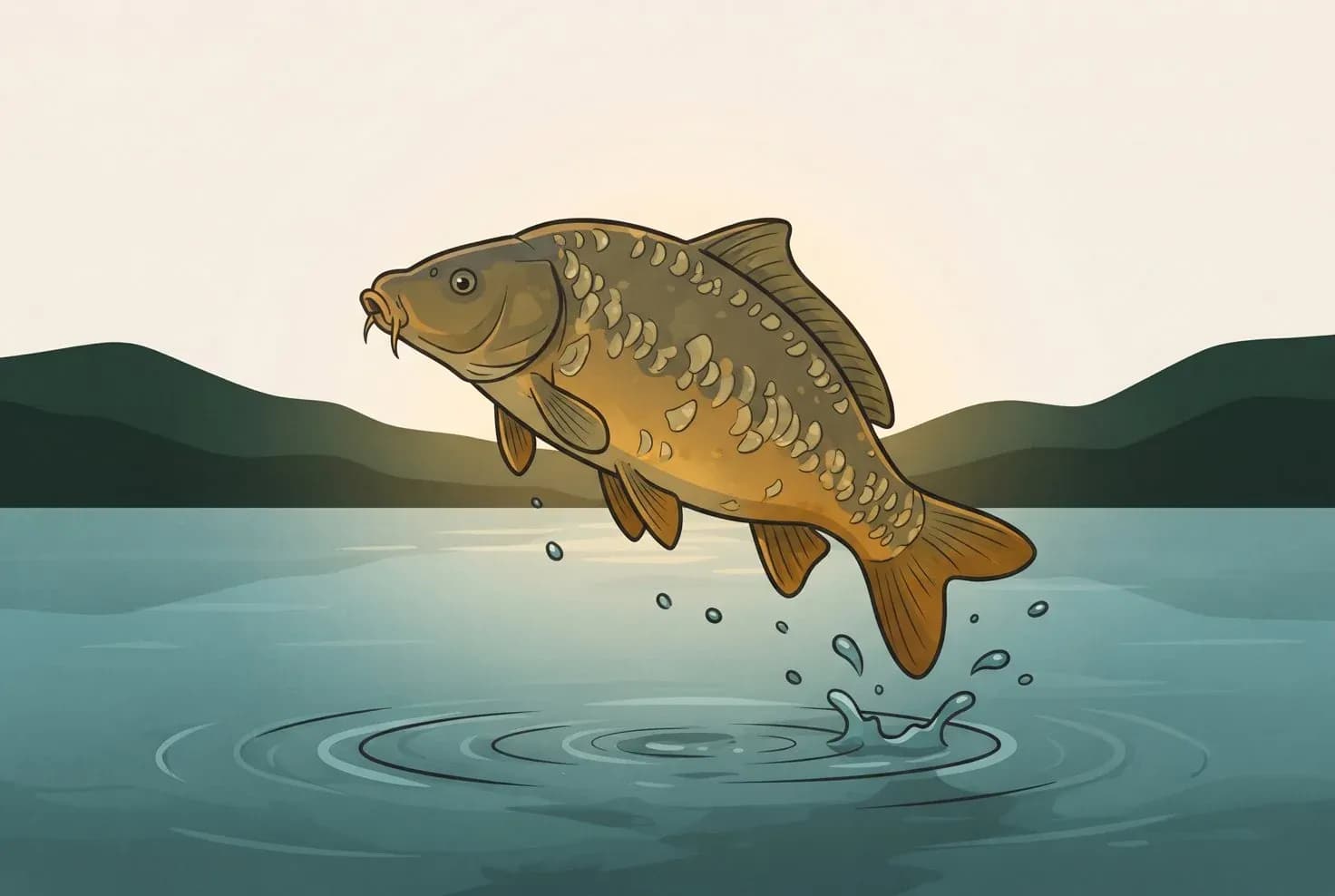
There are four types of surface manifestation: the full jump (whole body out, noisy, indicates presence, not feeding), the partial jump (head and half the body, falls flat, often precedes feeding), the roller (only the back, silent, fish high in the water column), and bubbling (fine cluster that moves, the only high-confidence sign).
The four classic mistakes when interpreting jumps:
- Casting on top of the jump. The fish that jumped isn't there any more, and the lead's impact right there spooks the rest. Cast 10–20 m from the jump, in the direction it came from or toward the nearest bottom feature.
- Confusing presence with feeding. A fish can jump over 12 m of clear water and be feeding 200 m away, over a plateau. The jump tells you there are carp in the reservoir and roughly where; not that they'll feed under your feet.
- Moving your gear with every jump. In a 24-hour session you'll see jumps everywhere. Packing up and re-rigging each time wastes time, makes noise, and leaves your bait never settled anywhere. Set a rule before you start: for example, "I move if I see three or more manifestations in the same area within an hour, and that area has a bottom feature".
- Ignoring the time of day. Jumps at dusk and dawn line up with the activity peaks described earlier and are worth more than jumps at three in the afternoon.
Common mistake: mistaking a barbel jump for a carp one. On many Spanish reservoirs barbel jump frequently, especially in spring near weirs and tails: their jumps are more vertical, thinner and often repeated by the same individual. An angler who reorganises their session around barbel jumps loses the whole night.
Liners: the most useful signal almost nobody uses
A liner is a bobbin movement caused by a fish brushing the line without taking the bait. Many anglers experience them as a nuisance. They're actually a free radar:
- Many liners, no bites → there are fish in the area but the bait isn't exactly where they're feeding, or the presentation isn't convincing. Adjust distance before changing the rig.
- Liners that stop suddenly → the fish have moved. Note the time: it will repeat.
- Liners on only one rod → that line crosses the travel route. Consider moving the others toward it.
- No liners all night → probably no fish within range of your lines. That's hard data: move at dawn.
This is the second part of a series based on the CapseMaster manual, 2026 edition. Fishing regulations change every season: this content does not replace the closed-season order currently in force in your region.
The whole CapseMaster series
- 1. What carpfishing is and carp biology, applied
- 2. Finding and reading carp
- 3. Gear and the rig catalogue
- 4. Baits and baiting
- 5. Nine complete strategies and fishing by season
- 6. Condition matrix, Spanish scenarios and session protocols
- 7. Big specimens, 50 mistakes and diagnosing at the swim
- 8. Fish care
- 9. Spanish carpfishing regulations
- 10. What to bring, 10-minute field guide, glossary and sources